See what's inside a full report
Maisy is getting ready for secondary school. Hannah is choosing her Leaving Cert subjects. Each section below lifts out a piece of their report so you can read it properly. Maisy and Hannah are example students.
Three things that stand out about Maisy
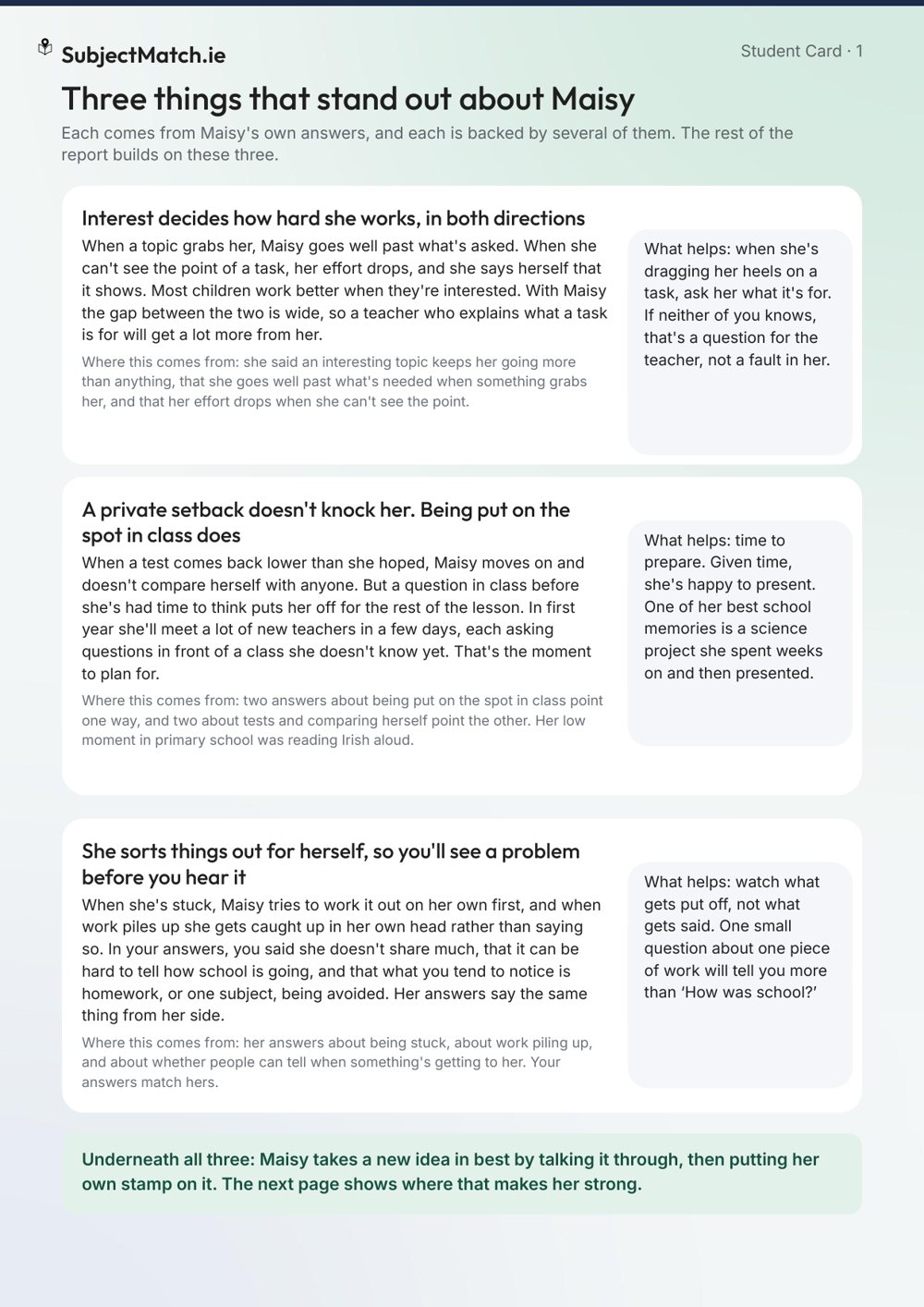
The report opens with the three patterns that came through most strongly in Maisy’s answers. Each is backed by several of them, says which answers it came from, and ends with what helps. Everything later in the report builds on these three.
Clear in her answers
A private setback doesn't knock her. Being put on the spot in class does
In first year she'll meet a lot of new teachers in a few days, each asking questions in front of a class she doesn't know yet. That's the moment to plan for.
What helps: time to prepare. Given time, she's happy to present.
The subjects that came out on top
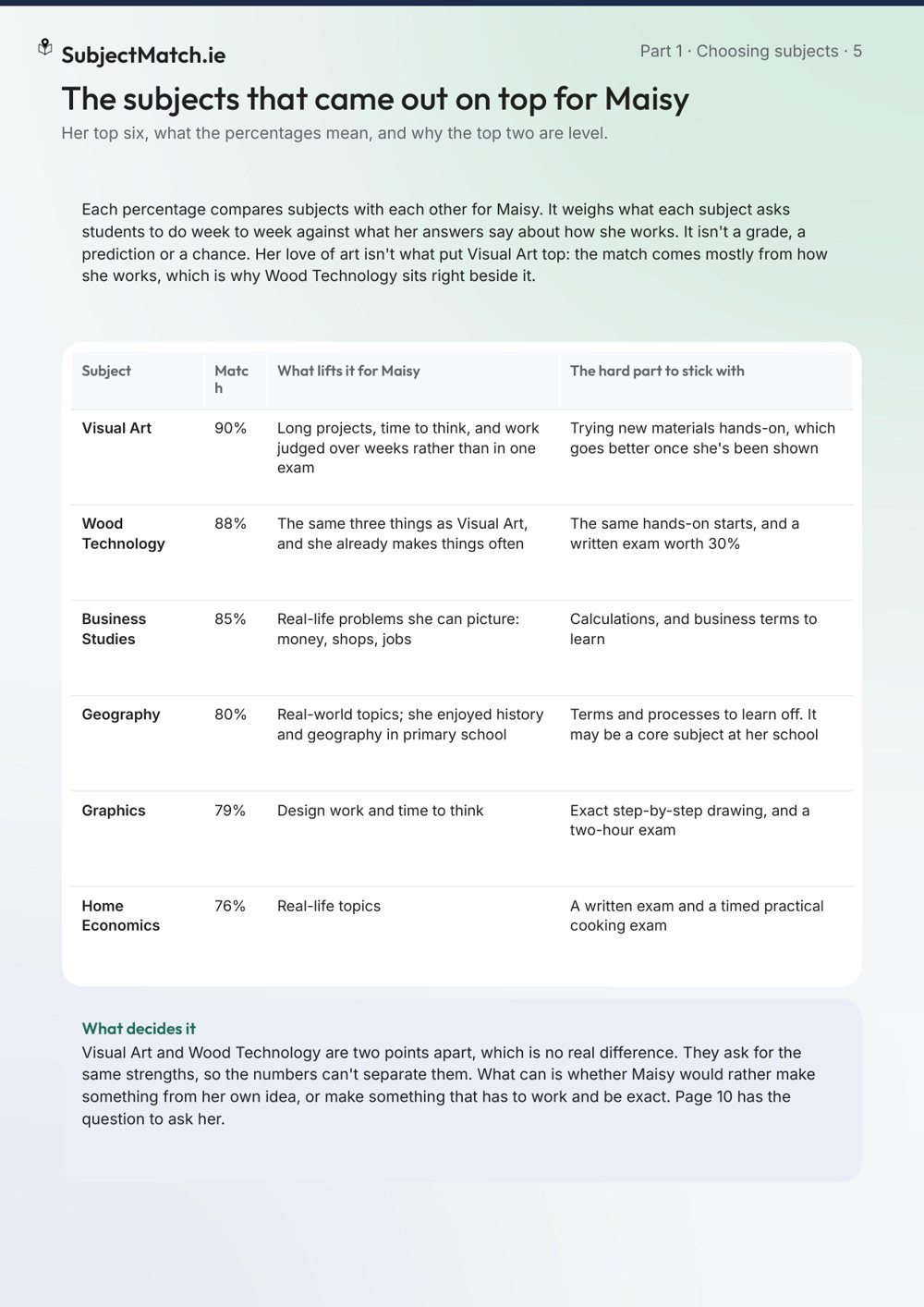
Maisy’s top six side by side: what lifts each subject for her, and the hard part she’d need to stick with. The page explains what the percentages mean, and why her love of art isn’t what put Visual Art first.
The subjects that came out on top for Maisy
| Subject | What lifts it for Maisy | Match |
|---|---|---|
| Visual Art | Long projects, time to think, and work judged over weeks rather than in one exam | 90% |
| Wood Technology | The same three things as Visual Art, and she already makes things often | 88% |
| Business Studies | Real-life problems she can picture: money, shops, jobs | 85% |
Each percentage compares subjects with each other for Maisy. It isn't a grade, a prediction or a chance.
When two subjects come out level
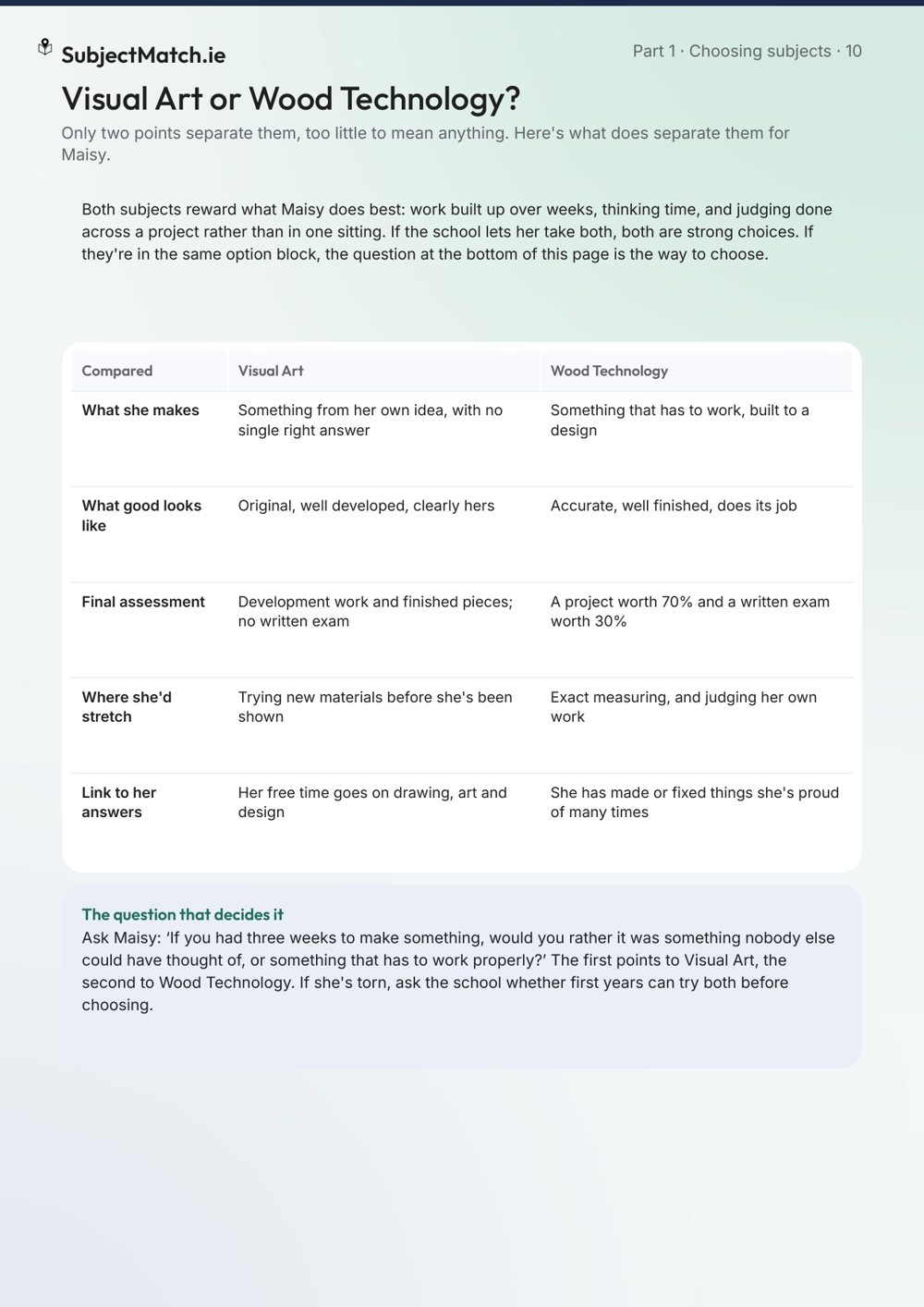
Two points is too little to mean anything, so the report doesn’t pretend it does. It sets the two subjects side by side, shows what each asks of her, and gives you the question that separates them.
Visual Art or Wood Technology?
Only two points separate them, too little to mean anything.
The question that decides it: ‘If you had three weeks to make something, would you rather it was something nobody else could have thought of, or something that has to work properly?’
What’s normal in the first weeks
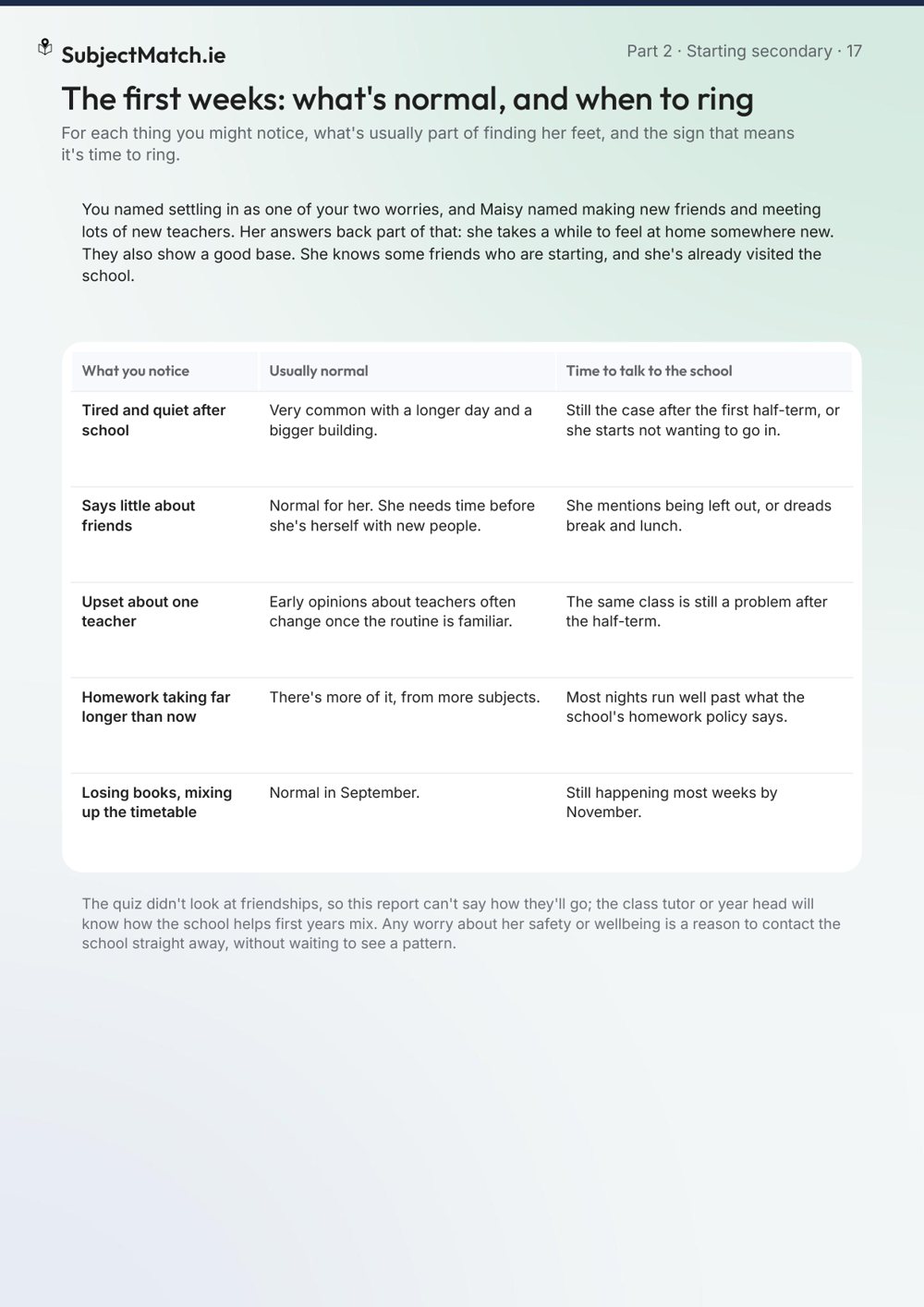
Maisy’s parent named settling in as a worry, so this page takes it on directly. For each thing you might notice in September, it says what’s usually part of finding her feet, and the sign that means it’s time to ring the school.
The first weeks: what's normal, and when to ring
| What you notice | Usually normal | Time to talk to the school |
|---|---|---|
| Tired and quiet after school | Very common with a longer day and a bigger building. | Still the case after the first half-term, or she starts not wanting to go in. |
| Losing books, mixing up the timetable | Normal in September. | Still happening most weeks by November. |
CBAs in plain words, and why they suit her
What a Classroom-Based Assessment is, how it’s judged and where the result appears. Then what CBAs will mean for Maisy, and the two things to plan for so she gets the most from them.
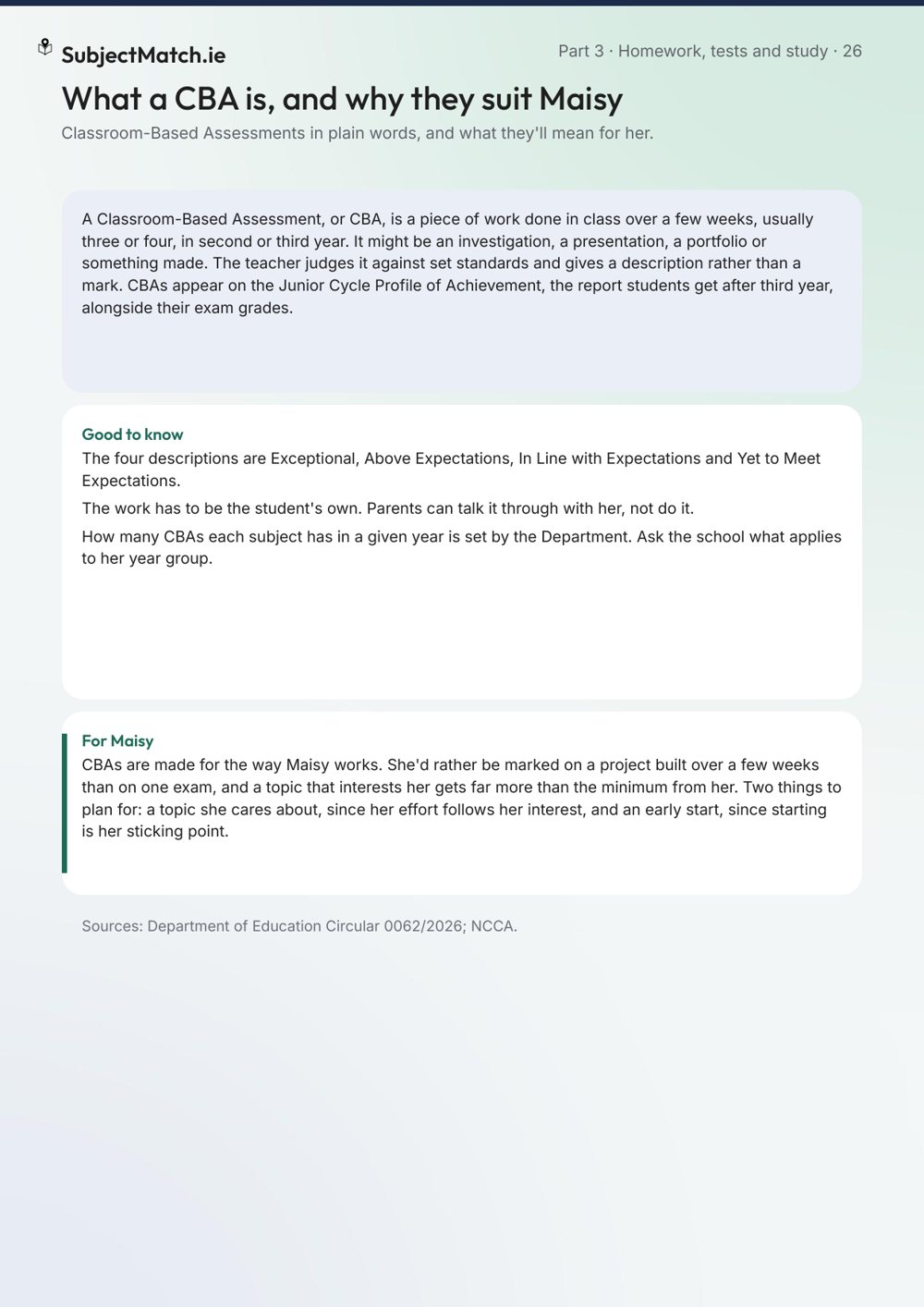
For Maisy
What a CBA is, and why they suit Maisy
CBAs are made for the way Maisy works. She'd rather be marked on a project built over a few weeks than on one exam.
Two things to plan for: a topic she cares about, since her effort follows her interest, and an early start, since starting is her sticking point.
Your part, in fifteen minutes a night
Part 4 is written for you. It starts with the three things that help most and the one thing to hold back from, all small enough for a school night, then covers parent-teacher meetings and ends with the fridge page.
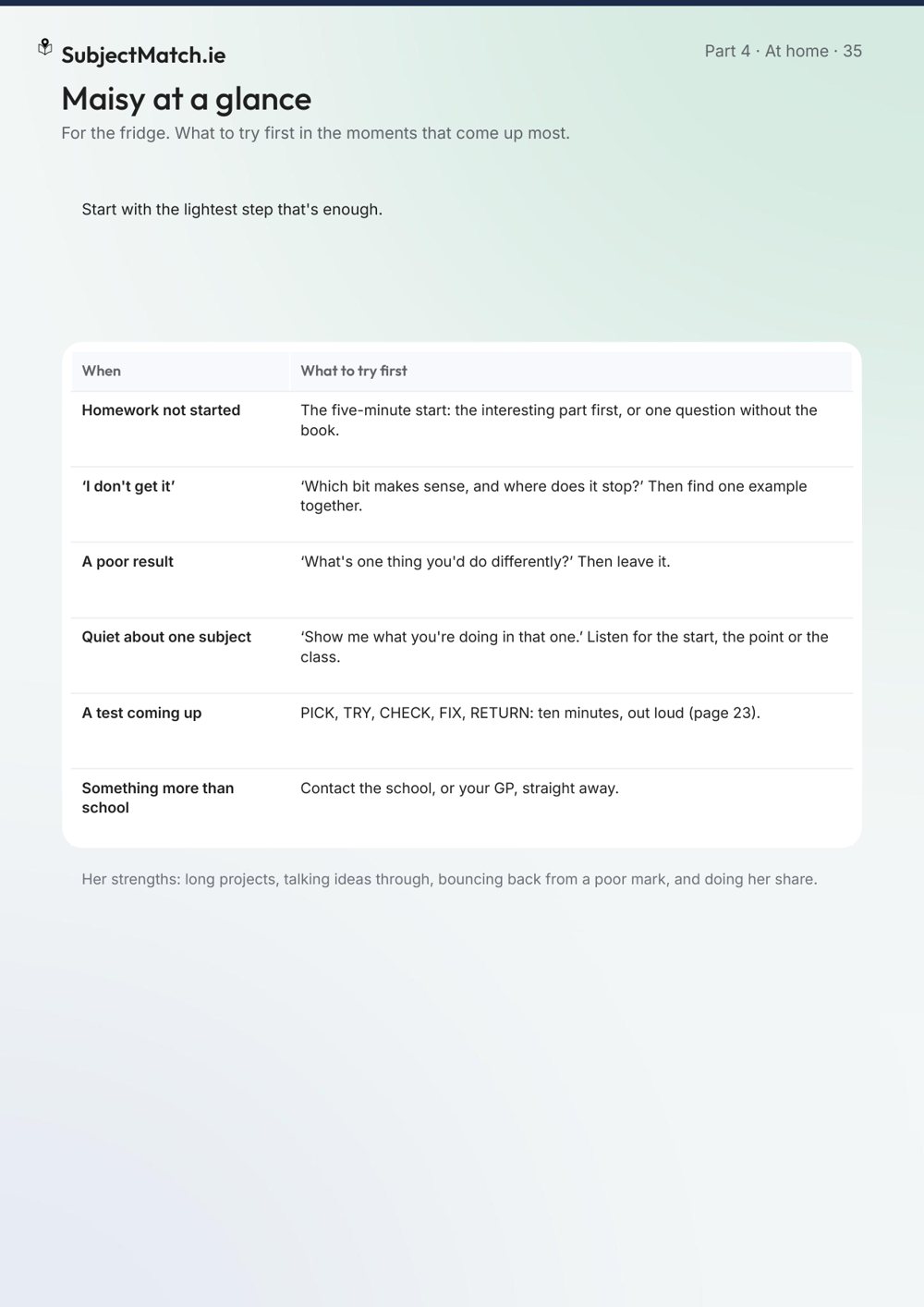
For the fridge
Maisy at a glance
| When | What to try first |
|---|---|
| Homework not started | The five-minute start: the interesting part first, or one question without the book. |
| A poor result | ‘What's one thing you'd do differently?’ Then leave it. |
| Quiet about one subject | ‘Show me what you're doing in that one.’ Listen for the start, the point or the class. |
Three things that stand out about Hannah
The three patterns that came through most strongly in Hannah’s answers, each backed by several of them and with a note on what helps. For a teenager who doesn’t share much, this part puts into words what they might not say.
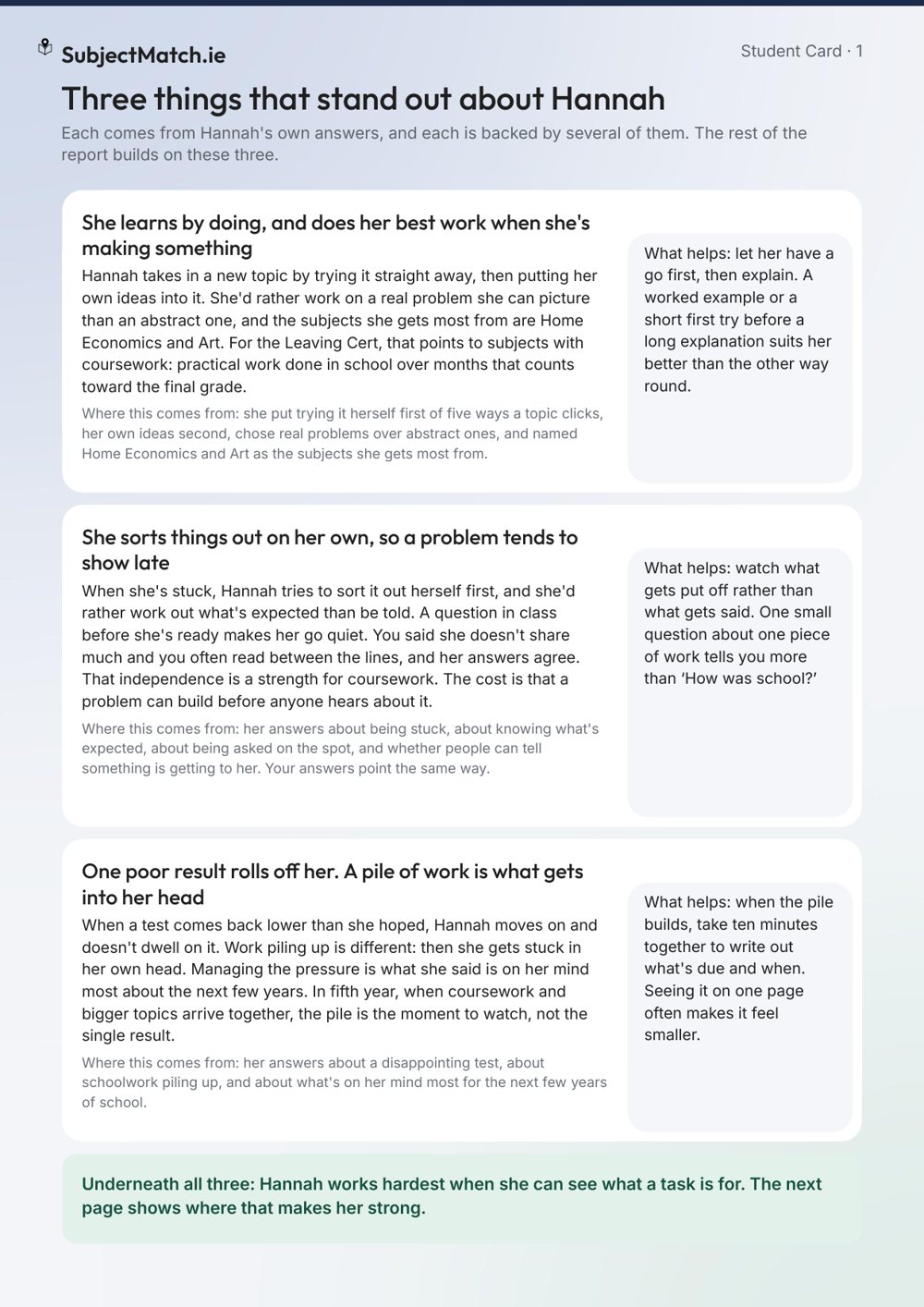
Clear in her answers
She sorts things out on her own, so a problem tends to show late
That independence is a strength for coursework. The cost is that a problem can build before anyone hears about it.
What helps: watch what gets put off rather than what gets said. One small question about one piece of work tells you more than ‘How was school?’
Her top subjects, and what the gap means
Hannah’s top six, with Art clearly ahead and the next five close together. The page explains which gaps mean something and which don’t, so you don’t read too much into a single point.
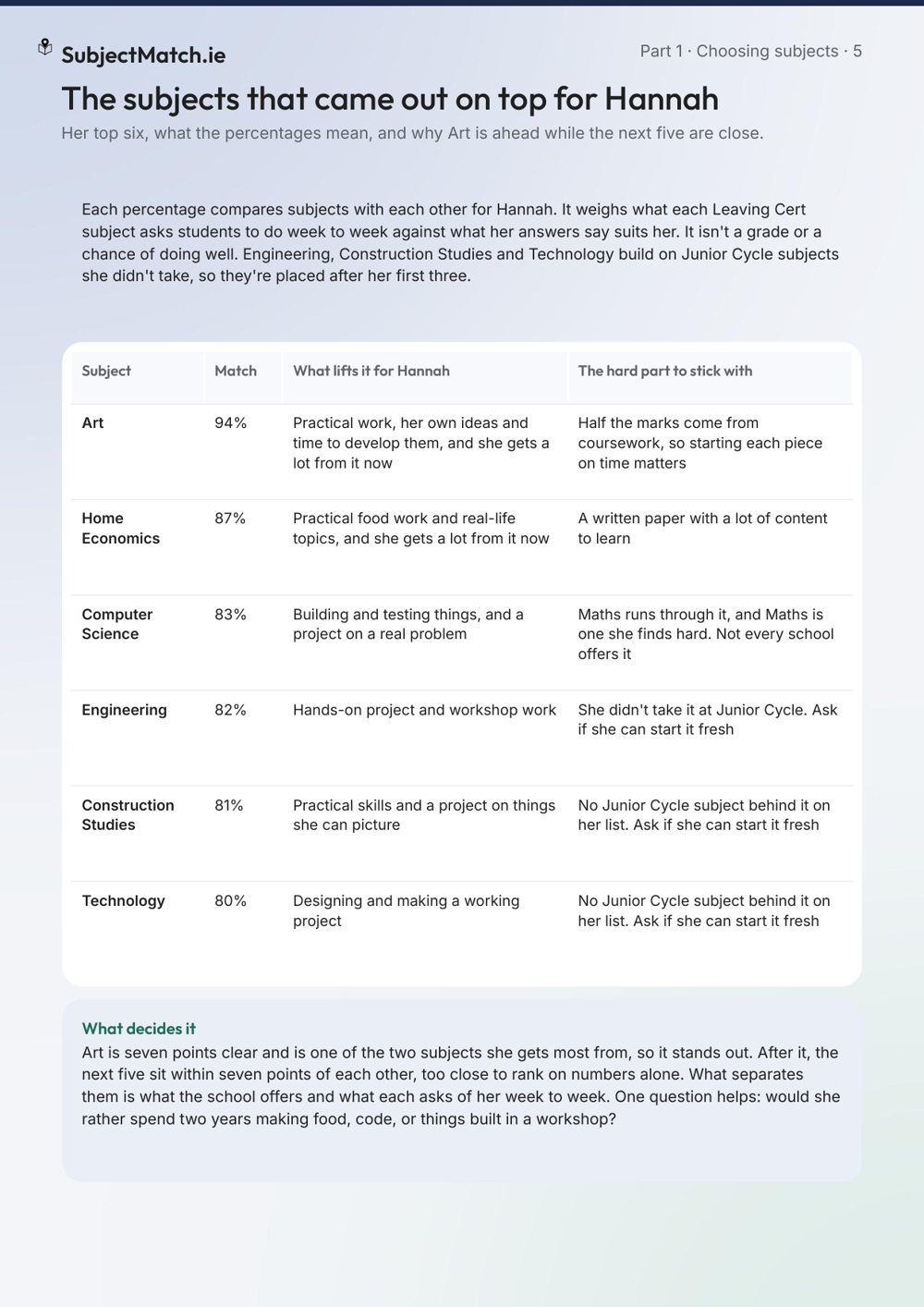
The subjects that came out on top for Hannah
| Subject | What lifts it for Hannah | Match |
|---|---|---|
| Art | Practical work, her own ideas and time to develop them, and she gets a lot from it now | 94% |
| Home Economics | Practical food work and real-life topics, and she gets a lot from it now | 87% |
| Computer Science | Building and testing things, and a project on a real problem | 83% |
Each percentage compares subjects with each other for Hannah. It isn't a grade or a chance of doing well.
Keeping a language, or not
Spanish came out near the bottom of Hannah’s list. This page explains why, what a Leaving Cert language involves, and what dropping it would and wouldn’t close off later.
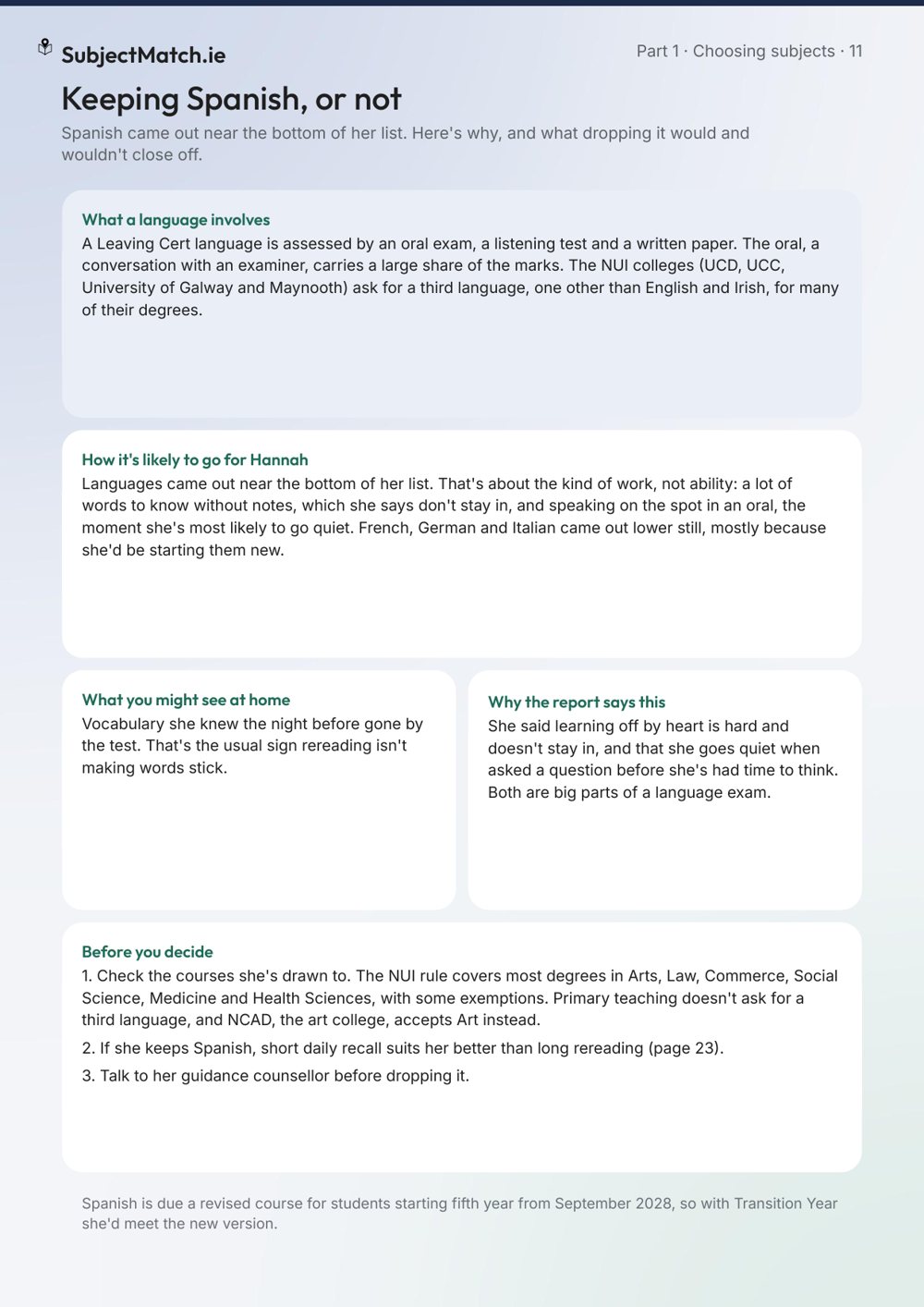
How it's likely to go for Hannah
Keeping Spanish, or not
Languages came out near the bottom of her list. That's about the kind of work, not ability: a lot of words to know without notes, and speaking on the spot in an oral.
Before you decide: check the courses she's drawn to. The NUI colleges ask for a third language for many of their degrees.
How her top three work together
Art, Home Economics and Computer Science as a set: what repeats, where the work stacks up, and what helps. All three have coursework, and that shapes the whole of sixth year.
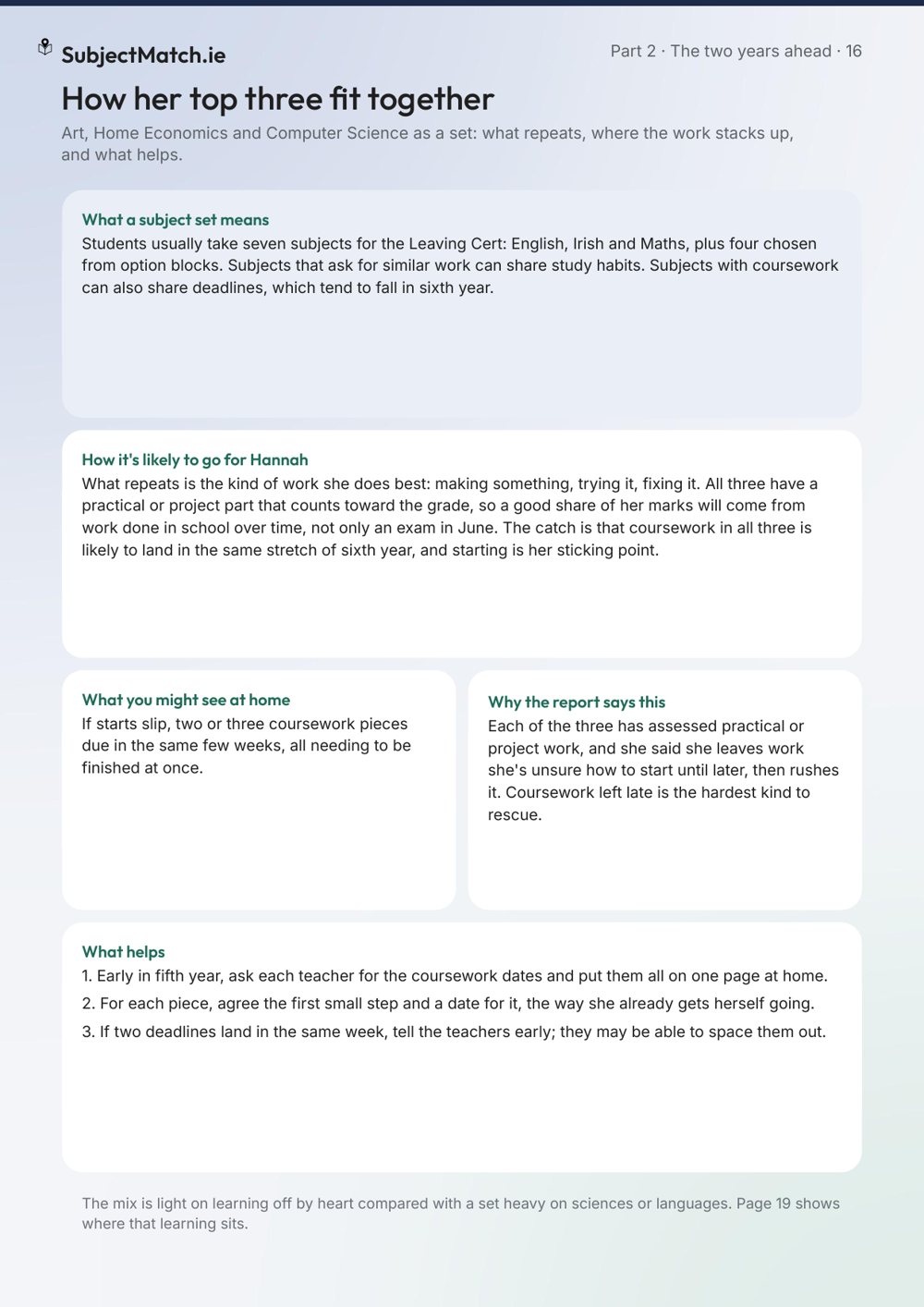
What you might see at home
How her top three fit together
If starts slip, two or three coursework pieces due in the same few weeks, all needing to be finished at once.
What helps: early in fifth year, ask each teacher for the coursework dates and put them all on one page at home.
What changes about study
How study has to change from Junior Cycle to fifth year, in plain words: bigger topics, two-year courses and coursework that counts. Then what that means for Hannah.
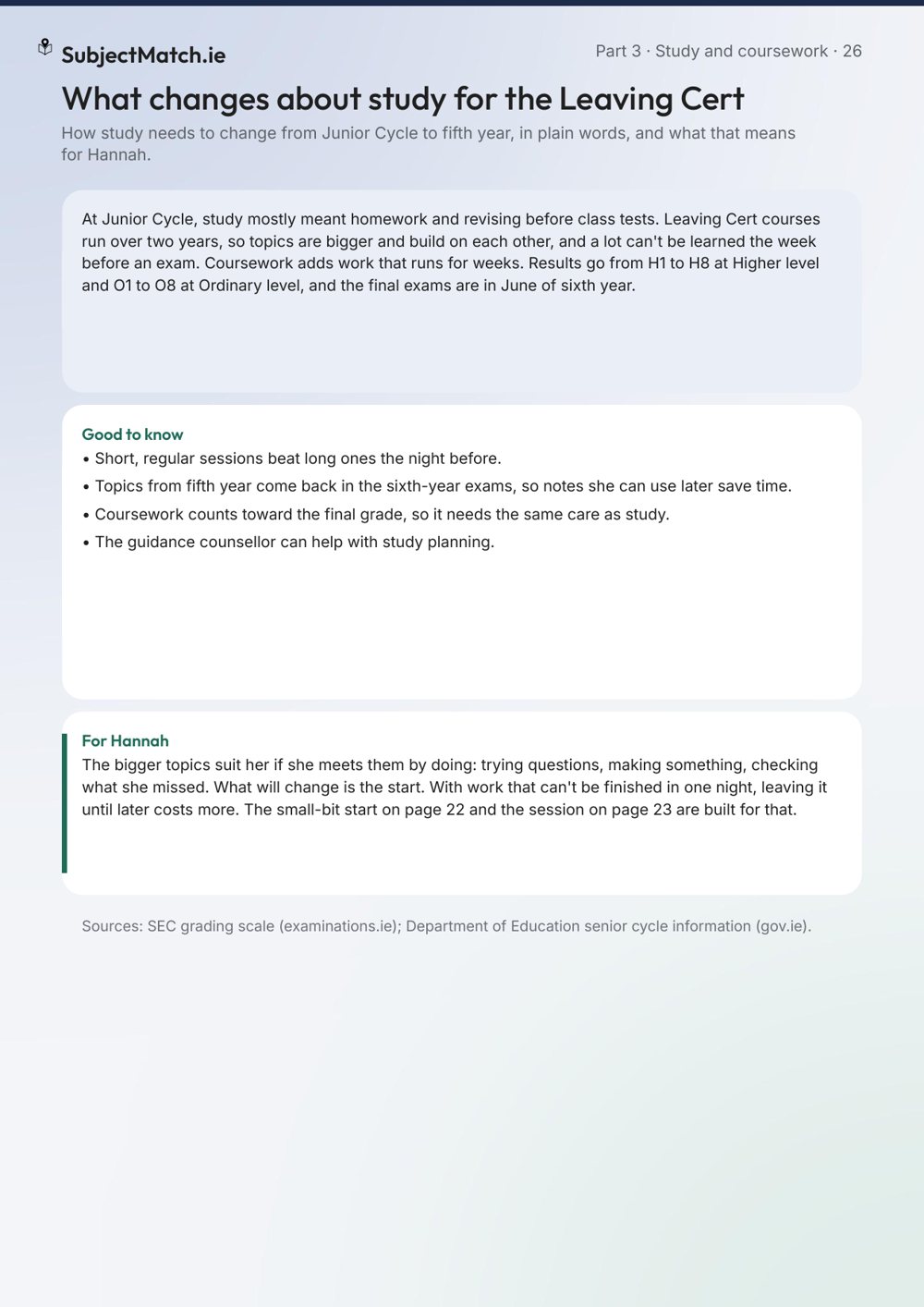
What changes about study for the Leaving Cert
Leaving Cert courses run over two years, so topics are bigger and build on each other, and a lot can't be learned the week before an exam.
For Hannah: the bigger topics suit her if she meets them by doing: trying questions, making something, checking what she missed.
When the pressure builds
Hannah’s parent named exam pressure as a worry, so it gets its own page. Four questions for the weeks it builds, and what to do after a poor result.
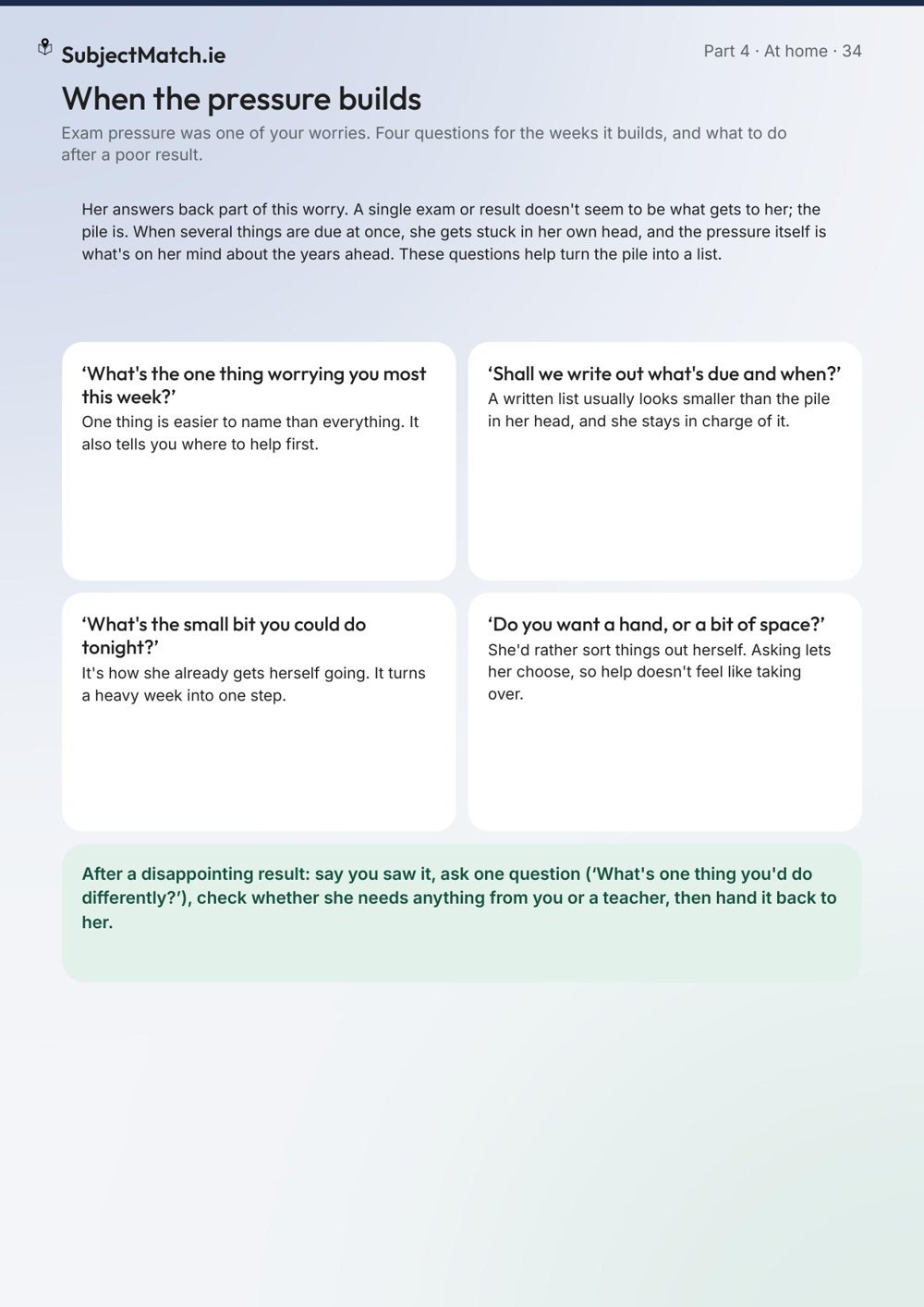
When the pressure builds
A single exam or result doesn't seem to be what gets to her; the pile is.
‘What's the small bit you could do tonight?’ It's how she already gets herself going. It turns a heavy week into one step.
‘Do you want a hand, or a bit of space?’ Asking lets her choose, so help doesn't feel like taking over.
That's six of 36 pages
Your child's report follows the same five parts, written from their answers and yours.