Your child will live with these subject choices for years. Don't let guesswork decide.

Everyone has advice: friends, teachers, other parents. But very little of it is about how your child actually works. That's why we built SubjectMatch. Spend 20 minutes answering questions together. Get a personalised, human-reviewed 36-page report: which subjects may suit them, what could be difficult, and what to ask before deciding.
Start your match

The worst time to understand a subject is after they have already chosen it.

Not sure yet? See six pages from an example report
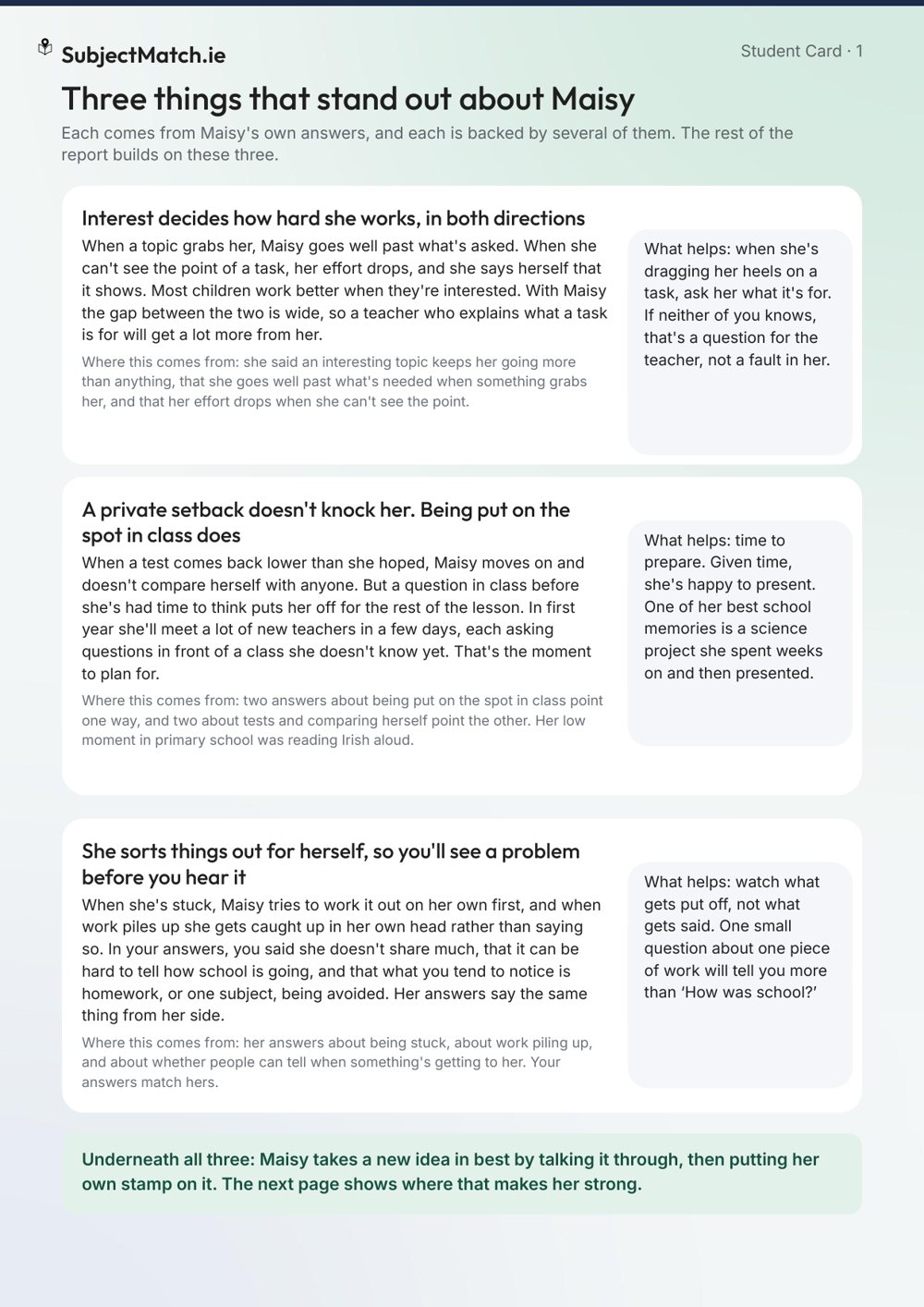
A page from Maisy's Junior Cycle report, Student Card, page 1

Clear in her answers

Interest decides how hard she works, in both directions

When a topic grabs her, Maisy goes well past what's asked. When she can't see the point of a task, her effort drops, and she says herself that it shows.

What helps: when she's dragging her heels on a task, ask her what it's for.

From Maisy's Junior Cycle report · Student Card, page 1

The conversation every parent knows.

Your child is drawn to one subject. Their friends are talking about another. You remember what someone said at an open night, and you are wondering which advice actually applies to your child.

None of that tells you what the weekly work will be like for them, where the difficult parts are, or what they might wish they had checked beforehand.

It does not have to be a guess this time.

THE PROBLEM WE BUILT SUBJECTMATCH TO SOLVE

The advice is everywhere. The answers aren't.

Families are asked to make a personal decision using mostly general information. What matters is how your child works, what each subject demands and what you still need to check.

01 / ADVICE

Everyone has an opinion

Friends share their experiences. Teachers explain their subjects. Parents look ahead. Useful perspectives—but none can replace understanding what suits your child.

02 / CONSEQUENCES

The ordinary work gets overlooked

A subject that sounds exciting can feel different once they are doing the work every week. The difficult bits deserve attention before a decision, not just after.

03 / SCHOOL SUPPORT

The next step isn't always obvious

Which subjects can they actually take? What should you ask the school? Which later requirements need checking? You need specific questions, not a vague feeling.

We built SubjectMatch to turn their answers into reasons you can use—before your child has already made the choice.

Start your match

Built in Ireland, around the Junior Cycle and Leaving Cert.

Every report is checked for accuracy and clarity before it's sent.

Used only to write your report. Never sold or shared.

We turn guesswork into reasons you can use

Not another generic subject guide. Five parts built around your child's answers, with reasons, trade-offs and next steps. Choose a part to see an actual page from a sample report.

A real page from a sample report: Three things that stand out
A real page from Maisy's report. Maisy is a sample student; your child's report is written from your child's answers and yours. Select the page to open it full size.

Pages 1 to 4 · 4 pages

Student Card

What your child's answers say about them, where they're strongest, and where a teacher could read them wrong. Every point shows the answers it comes from.

  • Three things that stand out about your child
  • Where your child is strongest
  • How your child could be misread, at school or at home
  • What's clear in the answers, and what's still to check

After you read itYou'll have the words to describe your child to the school.
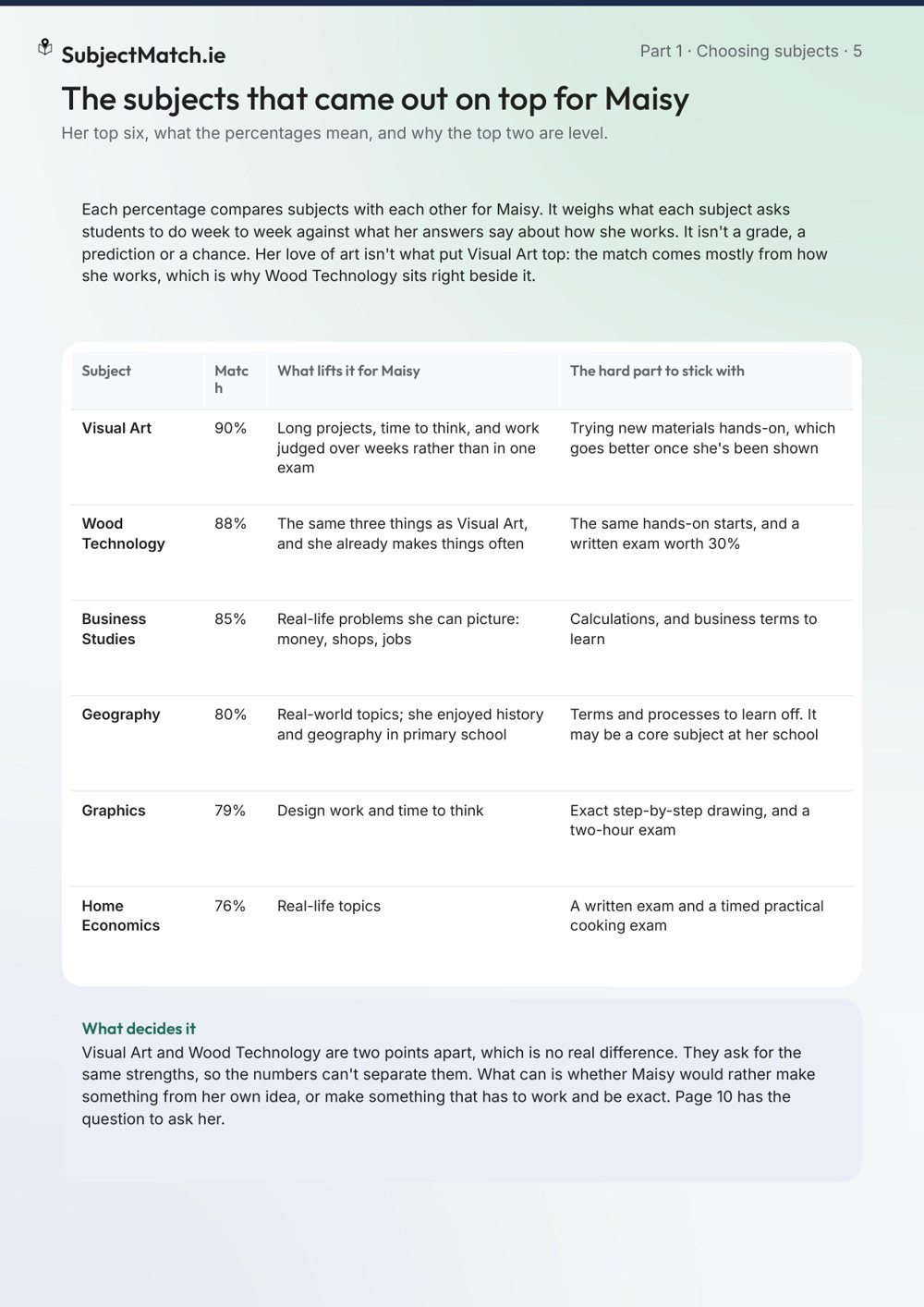
A real page from a sample report: The subjects that came out on top
A real page from Maisy's report. Maisy is a sample student; your child's report is written from your child's answers and yours. Select the page to open it full size.

Pages 5 to 14 · 10 pages

Part 1: Choosing subjects

Which subjects suit your child, by how much and why, and what each choice keeps open later.

  • The subjects that came out on top, and what the numbers mean
  • A page each on the top three: why it suits your child, and the hard part
  • A straight answer on a subject you named, or your child loves, that didn't make the top three
  • The closest call, and how to decide it
  • Languages
  • What each choice closes off or keeps open
  • Making a subject-choice plan to discuss with the school

After you read itYou'll have a shortlist you can explain, rather than another opinion to weigh up.
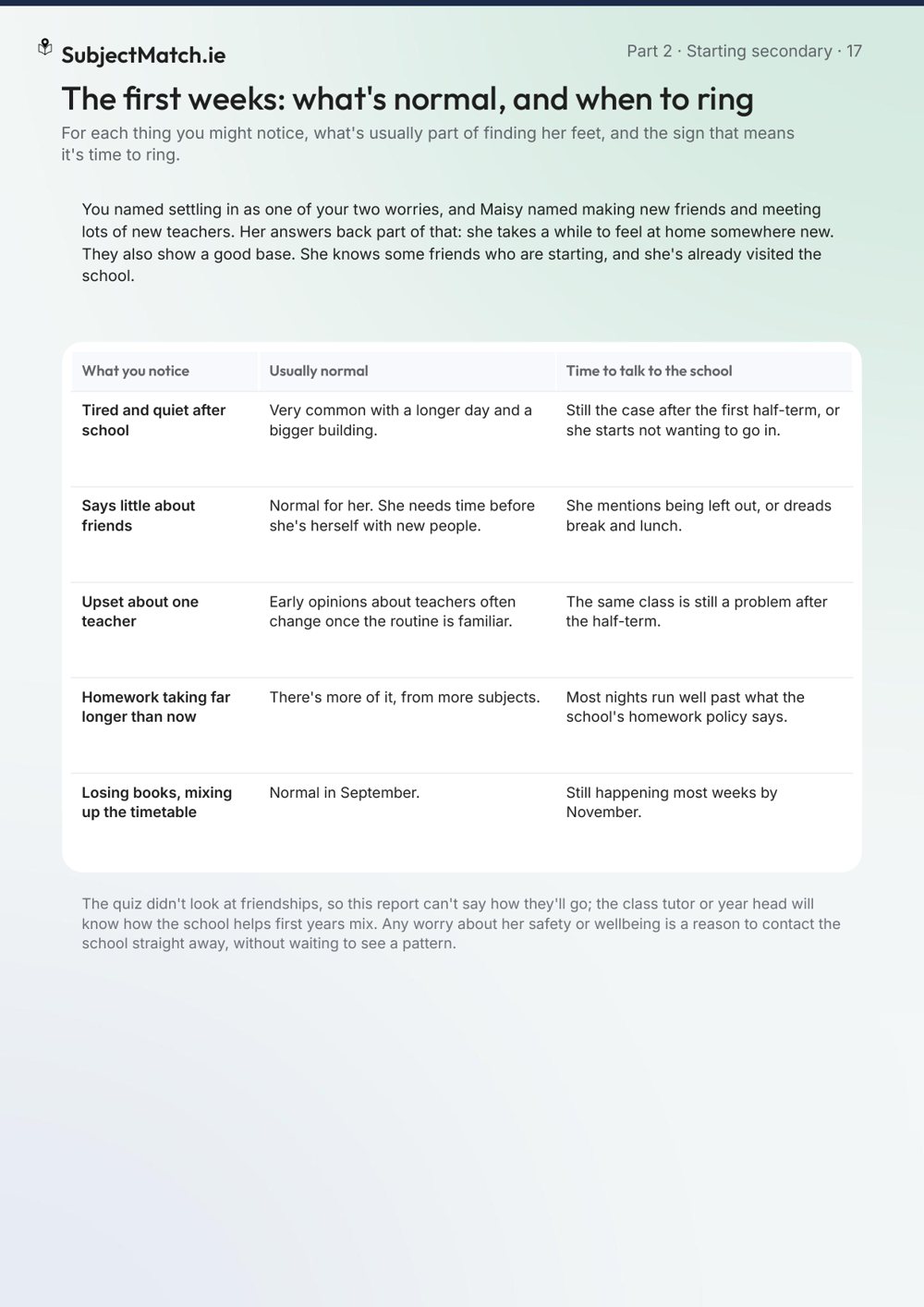
A real page from a sample report: The first weeks: what's normal, and when to ring
A real page from Maisy's report. Maisy is a sample student; your child's report is written from your child's answers and yours. Select the page to open it full size.

Pages 15 to 21 · 7 pages

Part 2: Starting secondary

What first year really looks like for your child, what's normal, and what isn't.

  • How secondary works compared with primary
  • A different teacher for every subject
  • The first weeks: what's normal, and when to ring
  • Things your child might say at home, and what they usually mean
  • Liking the teacher, not the subject
  • More independence, and how much to give
  • A page written to your child directly

After you read itYou know what's coming before it lands.
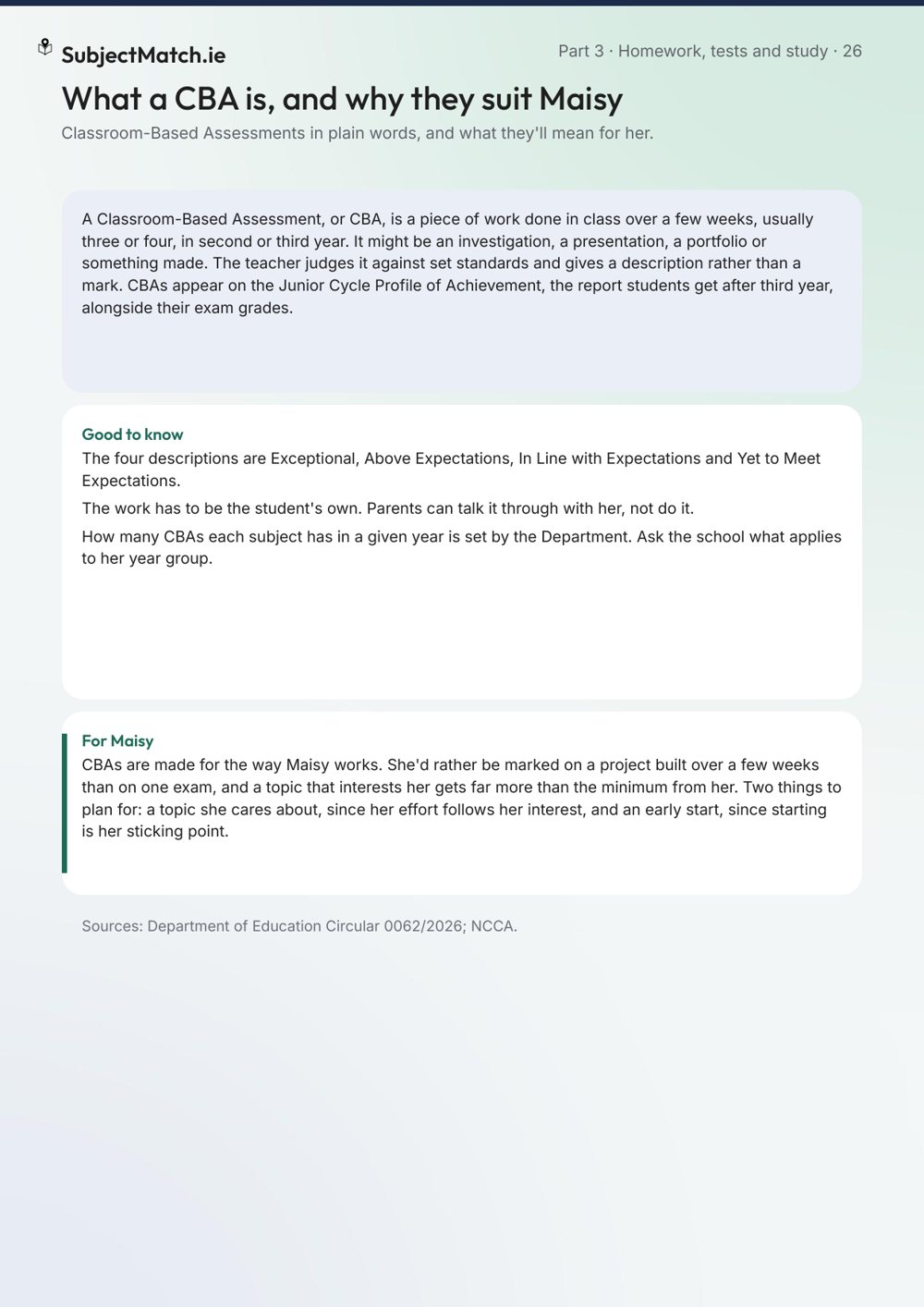
A real page from a sample report: What a CBA is, and why they suit Maisy
A real page from Maisy's report. Maisy is a sample student; your child's report is written from your child's answers and yours. Select the page to open it full size.

Pages 22 to 28 · 7 pages

Part 3: Homework, tests and study

A way of studying that suits how your child learns, broken down by subject, with a sample week.

  • Starting a routine
  • A study method that suits how your child learns
  • How to study each subject
  • Class tests, and the Christmas and summer exams
  • CBAs explained in plain words
  • Your child's CBAs, subject by subject
  • A sample study week

After you read itA plan on the table instead of a shout up the stairs.
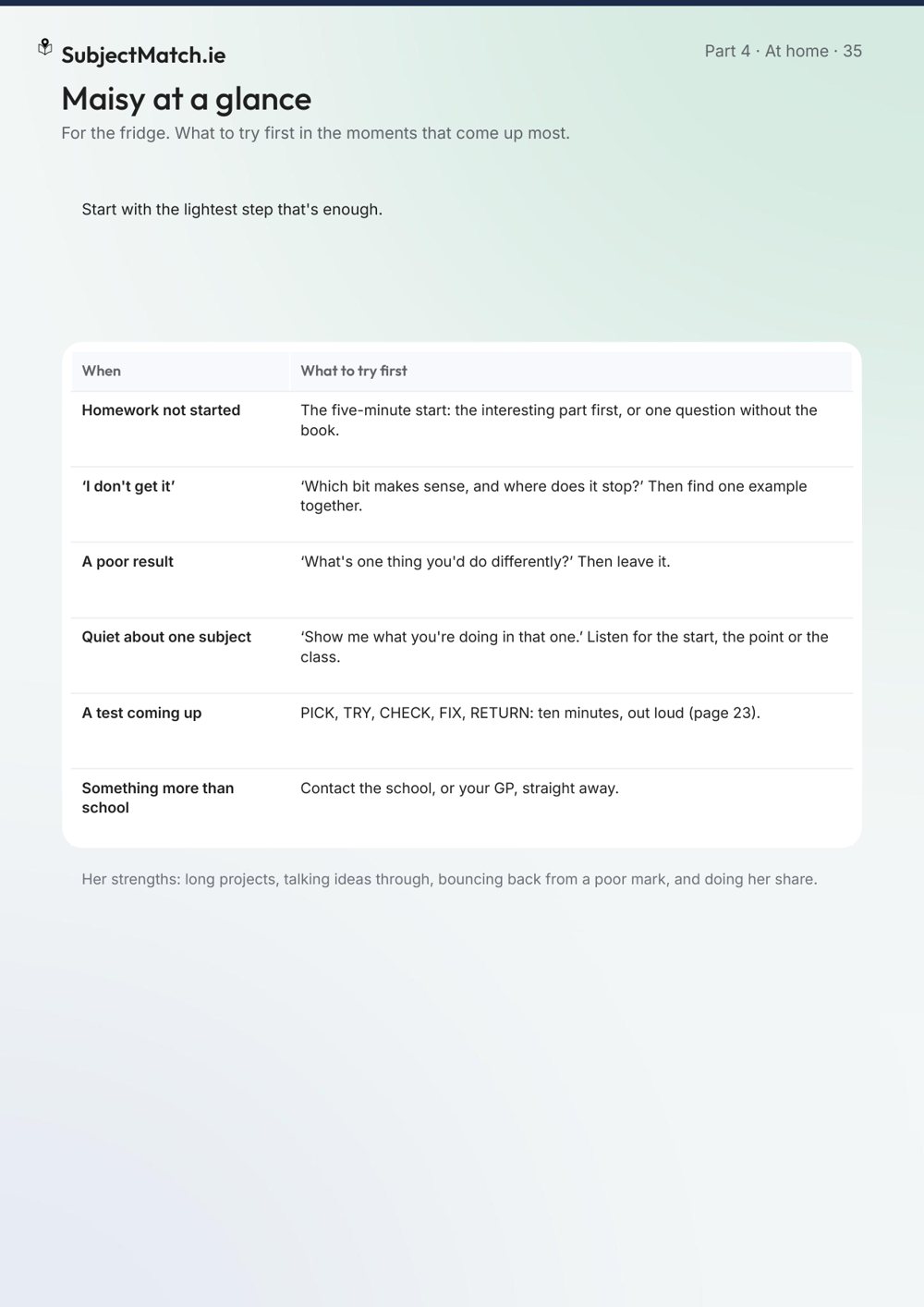
A real page from a sample report: Maisy at a glance, the page for the fridge
A real page from Maisy's report. Maisy is a sample student; your child's report is written from your child's answers and yours. Select the page to open it full size.

Pages 29 to 36 · 8 pages

Part 4: At home

Your part: when to step in, when to leave it, and a straight answer to the worry you wrote in the quiz.

  • A part written for you
  • When to leave it, and when to ring the school
  • A straight answer to the worry you wrote in the quiz
  • The subject your child might avoid, and what to do
  • Confidence or study help, depending on your answers
  • Exam pressure or parent-teacher meetings, depending on your answers
  • One page for the fridge
  • Next steps

After you read itInvolved without hovering. You know your part.
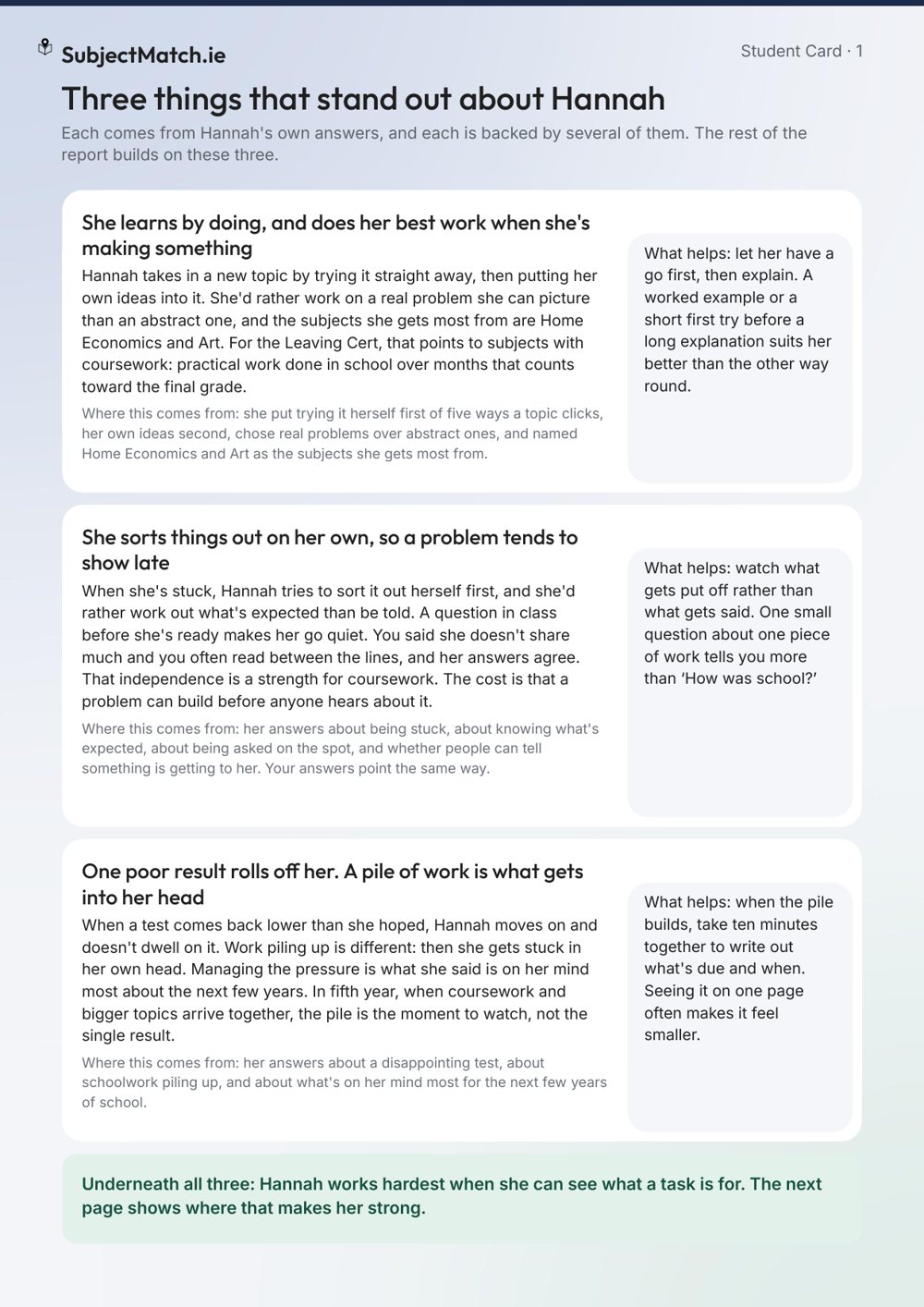
A real page from a sample report: Three things that stand out
A real page from Hannah's report. Hannah is a sample student; your child's report is written from your child's answers and yours. Select the page to open it full size.

Pages 1 to 4 · 4 pages

Student Card

What your child's answers say about them, where they're strongest, and where a teacher could read them wrong. Every point shows the answers it comes from.

  • Three things that stand out about your child
  • Where your child is strongest
  • How your child could be misread, at school or at home
  • What's clear in the answers, and what's still to check

After you read itYou'll have the words to describe your child to the school.
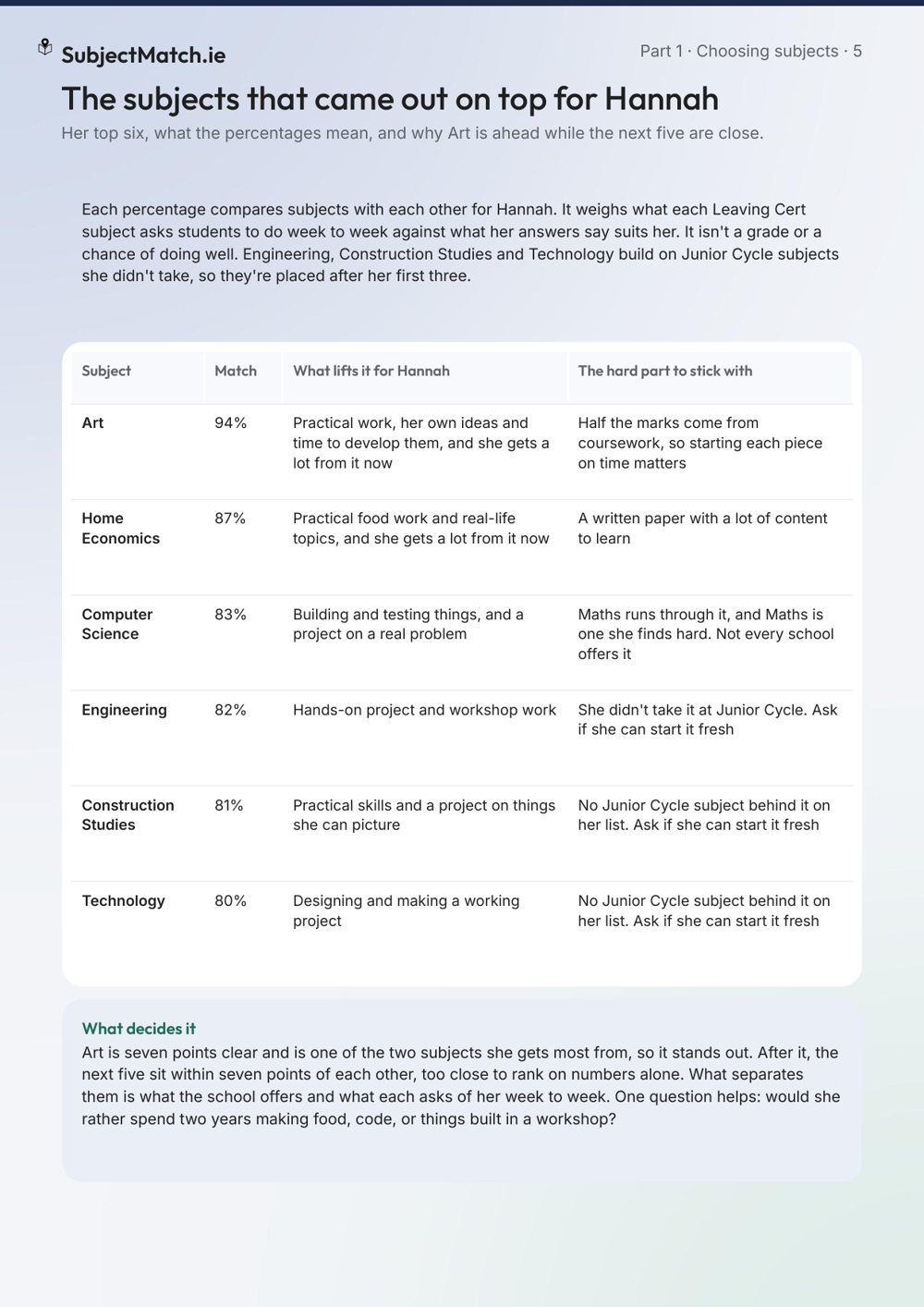
A real page from a sample report: The subjects that came out on top
A real page from Hannah's report. Hannah is a sample student; your child's report is written from your child's answers and yours. Select the page to open it full size.

Pages 5 to 14 · 10 pages

Part 1: Choosing subjects

Which subjects suit your child, by how much and why, how they work as a set, and what each choice means for college courses later.

  • The subjects that came out on top, and what the numbers mean
  • A page each on the top three: why it suits your child, and the hard part
  • A straight answer on a subject you named, or your child loves, that didn't make the top three
  • The closest call, and how to decide it
  • Languages, and the college courses that ask for one
  • What each choice keeps open for college
  • Making a subject-choice plan to discuss with the school

After you read itYou'll have a shortlist you can explain, rather than another opinion to weigh up.
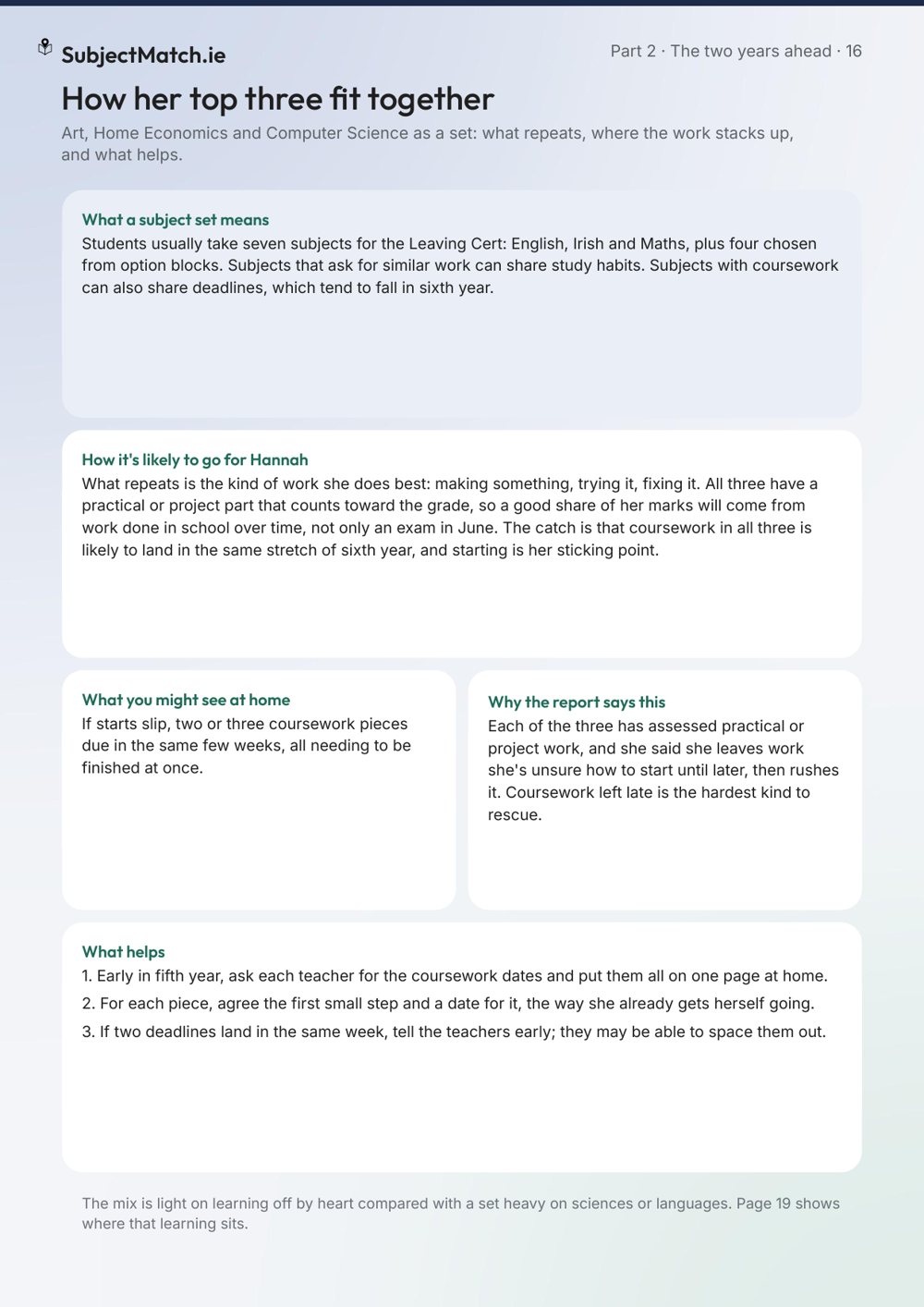
A real page from a sample report: How her top three work together
A real page from Hannah's report. Hannah is a sample student; your child's report is written from your child's answers and yours. Select the page to open it full size.

Pages 15 to 21 · 7 pages

Part 2: The two years ahead

How fifth and sixth year will go for your child, and where they usually get heavy.

  • How fifth and sixth year work
  • How your child's subjects work together
  • The two years, stretch by stretch
  • Things your child might say at home, and what they usually mean
  • Learning off, and when it stops working
  • What to do if a subject turns out wrong
  • A page written to your child directly

After you read itYou know what's coming before it lands.
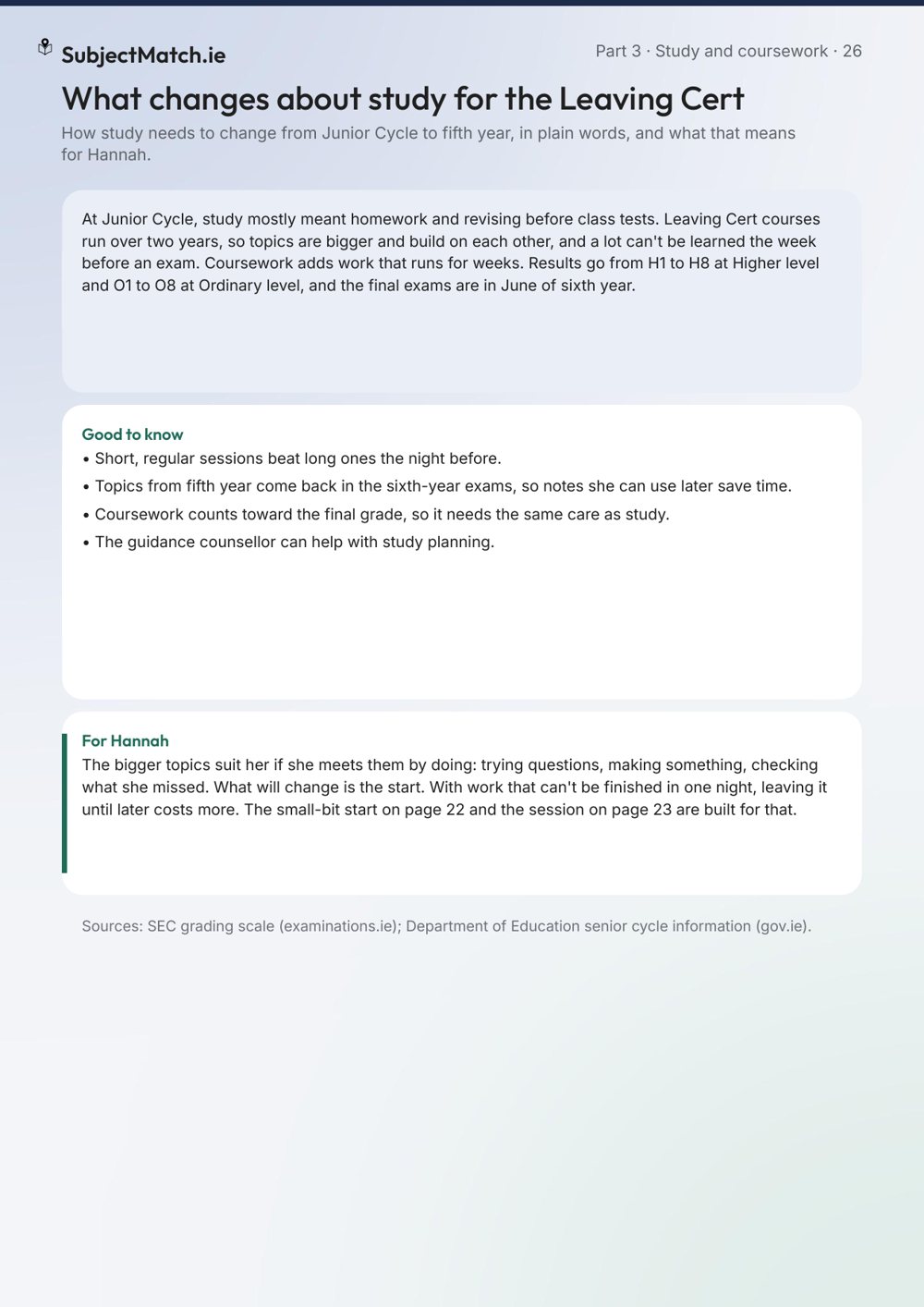
A real page from a sample report: What changes about study for the Leaving Cert
A real page from Hannah's report. Hannah is a sample student; your child's report is written from your child's answers and yours. Select the page to open it full size.

Pages 22 to 28 · 7 pages

Part 3: Study and coursework

A way of studying that suits how your child learns, broken down by subject, with a sample week.

  • Starting a routine
  • A study method that suits how your child learns
  • How to study each subject
  • Class tests, and the exams in June
  • Coursework explained in plain words
  • Your child's coursework, subject by subject
  • A sample study week

After you read itA plan on the table instead of a shout up the stairs.
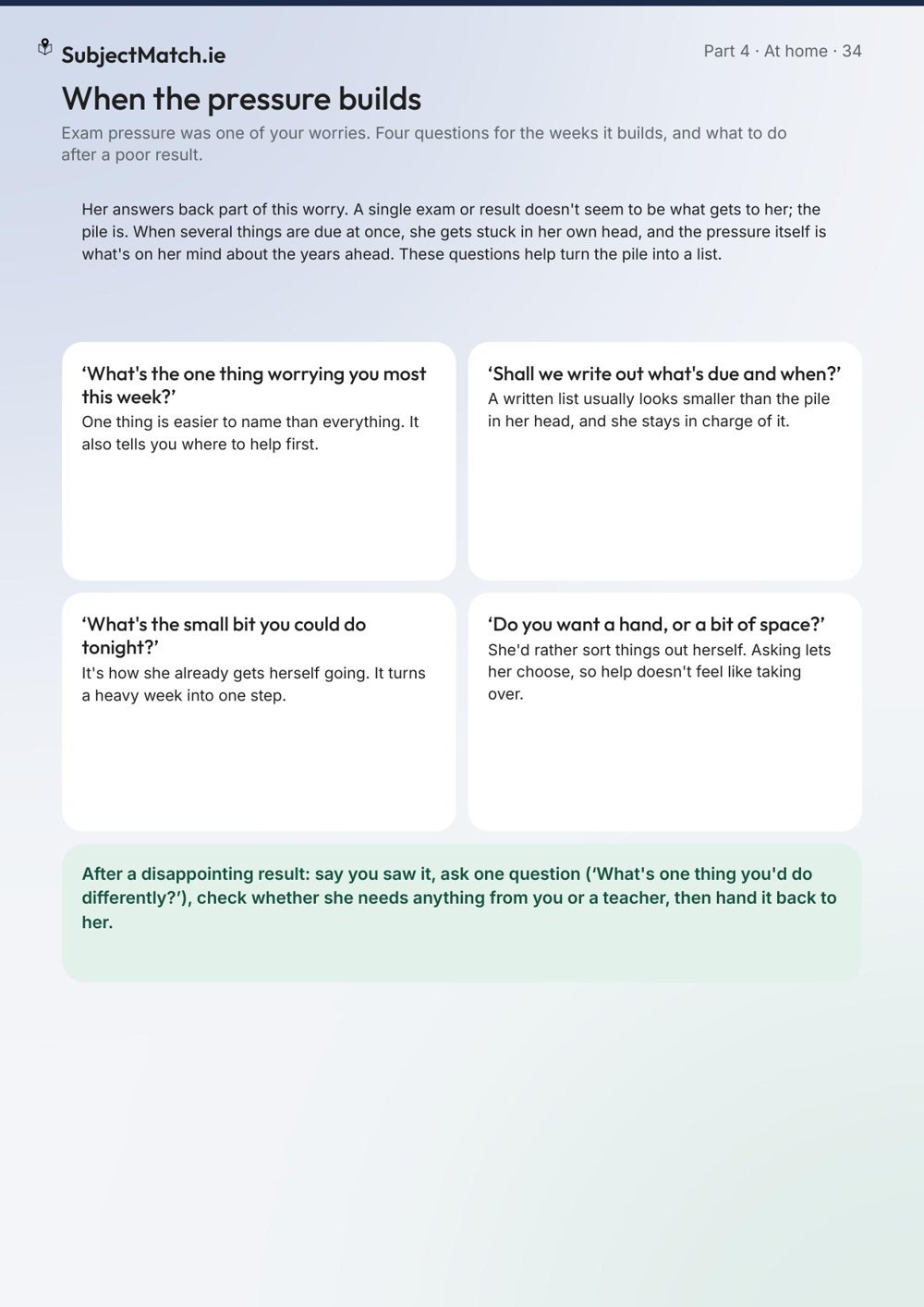
A real page from a sample report: When the pressure builds
A real page from Hannah's report. Hannah is a sample student; your child's report is written from your child's answers and yours. Select the page to open it full size.

Pages 29 to 36 · 8 pages

Part 4: At home

Your part: when to step in, when to leave it, and a straight answer to the worry you wrote in the quiz.

  • A part written for you
  • When to leave it, and when to ring the school
  • A straight answer to the worry you wrote in the quiz
  • The subject your child might avoid, and what to do
  • Confidence or study help, depending on your answers
  • Exam pressure or parent-teacher meetings, depending on your answers
  • One page for the fridge
  • Next steps

After you read itInvolved without hovering. You know your part.

A page from Hannah's Leaving Cert report, Student Card, page 1

Clear in her answers

She learns by doing, and does her best work when she's making something

Hannah takes in a new topic by trying it straight away, then putting her own ideas into it.

What helps: let her have a go first, then explain.

From Hannah's Leaving Cert report · Student Card, page 1

Not just a score. The reasons behind it.

Every recommendation connects to what your child actually answered. We separate stronger patterns from close calls, explain why a subject may suit them, and show what still needs checking. Because a decision this important deserves more than a percentage.

Clear in their answersLikelyCheck with them

The subject percentages compare subjects with each other for your child. They aren't grades, predictions or chances.

BUILT FOR YOUR CHILD'S NEXT BIG CHOICE

Is this the decision you are facing?

You don't need the perfect answer yet. You need a clearer way to work through the choices together.

  • ✓Your child is in 4th to 6th class and you want them to start secondary knowing what's coming.
  • ✓Your teenager is weighing Leaving Cert subjects and wants to understand the trade-offs.
  • ✓You and your child don't agree on what they should pick.
  • ✓You're not sure how much the subjects picked now matter later.

Twenty minutes now. Better questions before they choose.

  1. 1

    Tell us how your child works

    Your child shares what they enjoy, what they find difficult and how they like to work. About 20 minutes together.

  2. 2

    Add what only you know

    Tell us what you notice at home, the subject you're wondering about or a worry you'd like the report to address.

  3. 3

    We connect their answers to subjects

    Our scoring system compares their answers with subject demands. Our team reviews and curates the report before it goes out.

  4. 4

    Get reasons you can use

    Your personalised PDF arrives by email, with delivery timing confirmed before you pay.

How the report is made

Why I built SubjectMatch

I'm Shane, and I'm 20. I picked my subjects not long ago, with a timetable and a guess. Later I found out things my parents and I would have wanted to know at the start. This is the report I wish had been on our kitchen table.

Shane, founder

Read our mission

A decision this important deserves more than a guess.

One payment of €49.99 for the full Junior Cycle or Leaving Cert report: subject matches with reasons, important trade-offs and practical next steps. Nothing extra to buy later. If any part is unclear, reply to the email and we'll rewrite that part.

A report about your child, not the average student

€49.99
Student Card: what stands out about them Choosing subjects, with a subject plan The years ahead and what to expect Study, tests and coursework At home, ending with the fridge page
Start your match

You pay at the end of the quiz. Refund policy

Questions parents ask

All questions
What do the percentages mean?

They show which subjects appear to suit your child better than others, based on what each subject asks of students and how your child answered. They aren't predicted grades or chances of success. When two subjects are close, the report suggests a question to help you choose.

Does this replace the guidance counsellor?

No. It gives you a clear starting point and the questions to ask, so the meeting with the school goes further.

What if we don’t agree with the results?

That's worth talking through. The report shows which answers support each finding, so you can see what feels right, what needs checking and where your view differs. It's a starting point, not the final word.

Can I ask about a subject that isn’t in the top six?

Yes. Name it in the parent section and the report gives it its own page, explaining where it came out for your child and why.

How is the report made?

Our scoring system builds your child’s profile and subject matches from their answers and our Irish subject information. The writing is drafted with AI-assisted tools from that profile, and our team curates every report before it’s sent.

They'll have to make the choice. You can make sure they understand it.

A subject can look very different once you're studying it every week. Help your child understand their options, the difficult parts and the questions worth asking before they decide.

Start your match

Free guides to choosing school subjects in Ireland

Before you buy a report, start with the questions that matter: the school's real options, the work each subject involves and the trade-offs worth discussing together.

For families who want more than a guess

Subject choice in Ireland has always run on a booklet, an options night and a chat in the car. I was the child in that car. I picked subjects with almost nothing to go on, and so did my parents. SubjectMatch is for the parents who've decided their child won't go through that. You sit down together for twenty minutes, your child answers honestly, you add what you know, and what comes back is about them, not a general guide with their name dropped in. Shane, founder. I read every report before it goes out.