How the report is made
Two questions decide a good subject choice.
Will your child manage it, and will they care about it? Researchers who study how young people choose subjects keep landing on those same two things. So that's what the report is built around: your child's answers, read carefully, against what each subject asks of a student week to week.
Built on what the research says
Every part of the report answers something researchers found matters. Here's what they found, and what the report does about it.
Students choose subjects, and stick with them, when two things line up: they expect to do well, and they value the subject, because they enjoy it, it's useful to them or it feels like them. Researchers also count the cost: the effort and stress a subject will take.
Expectancy-value theory, Eccles and colleagues
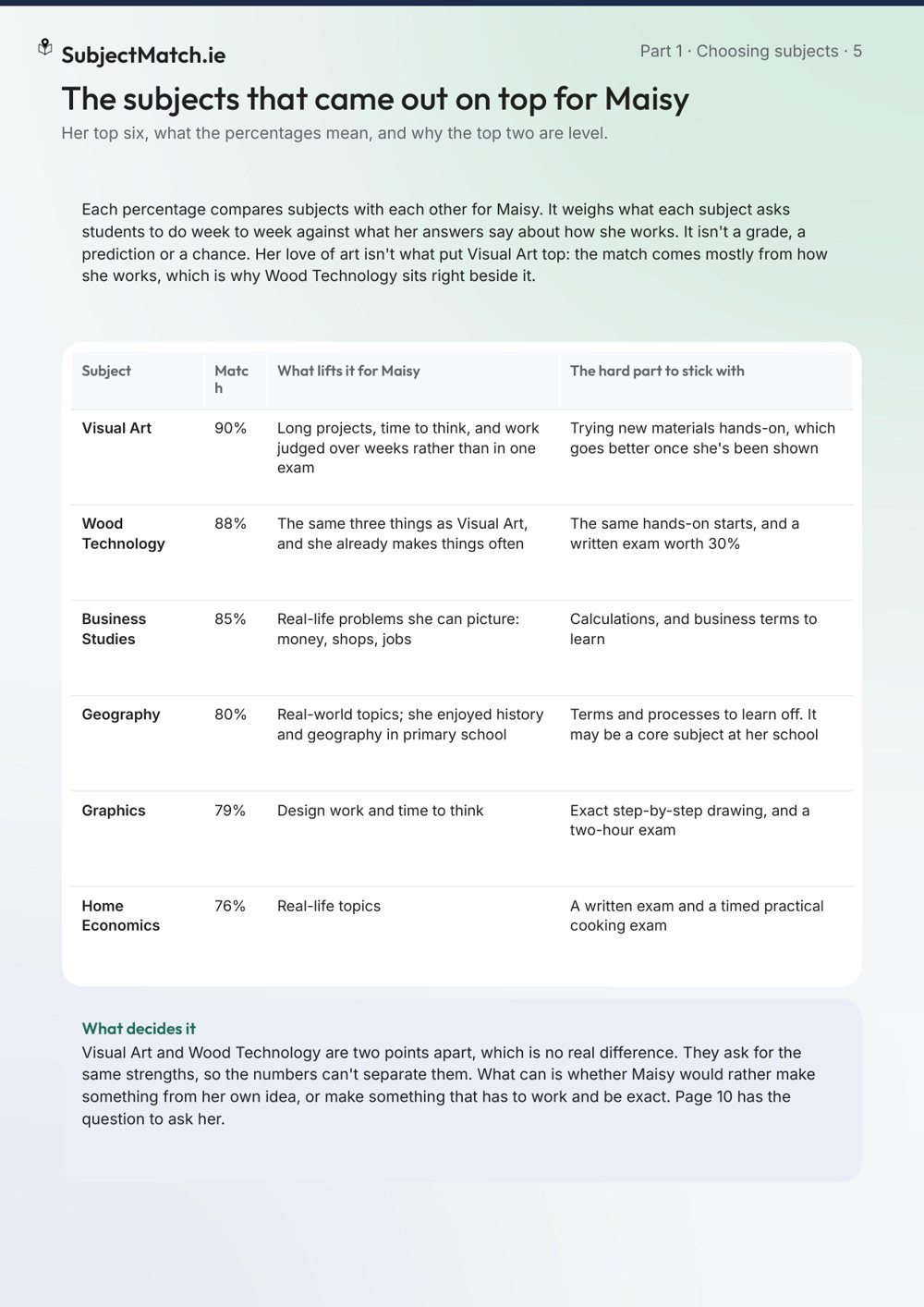
Weighs both sides for every subject: what your child enjoys and values, and what their answers say about how they work. Every top subject also gets a "hard part to stick with", so you see the cost as well as the appeal.
In Ireland, parents are the main source of advice on subject choice, ahead of guidance counsellors. Many students say they wanted more information on what a subject involves and where it leads.
ESRI, Choices and Challenges, Smyth and Calvert
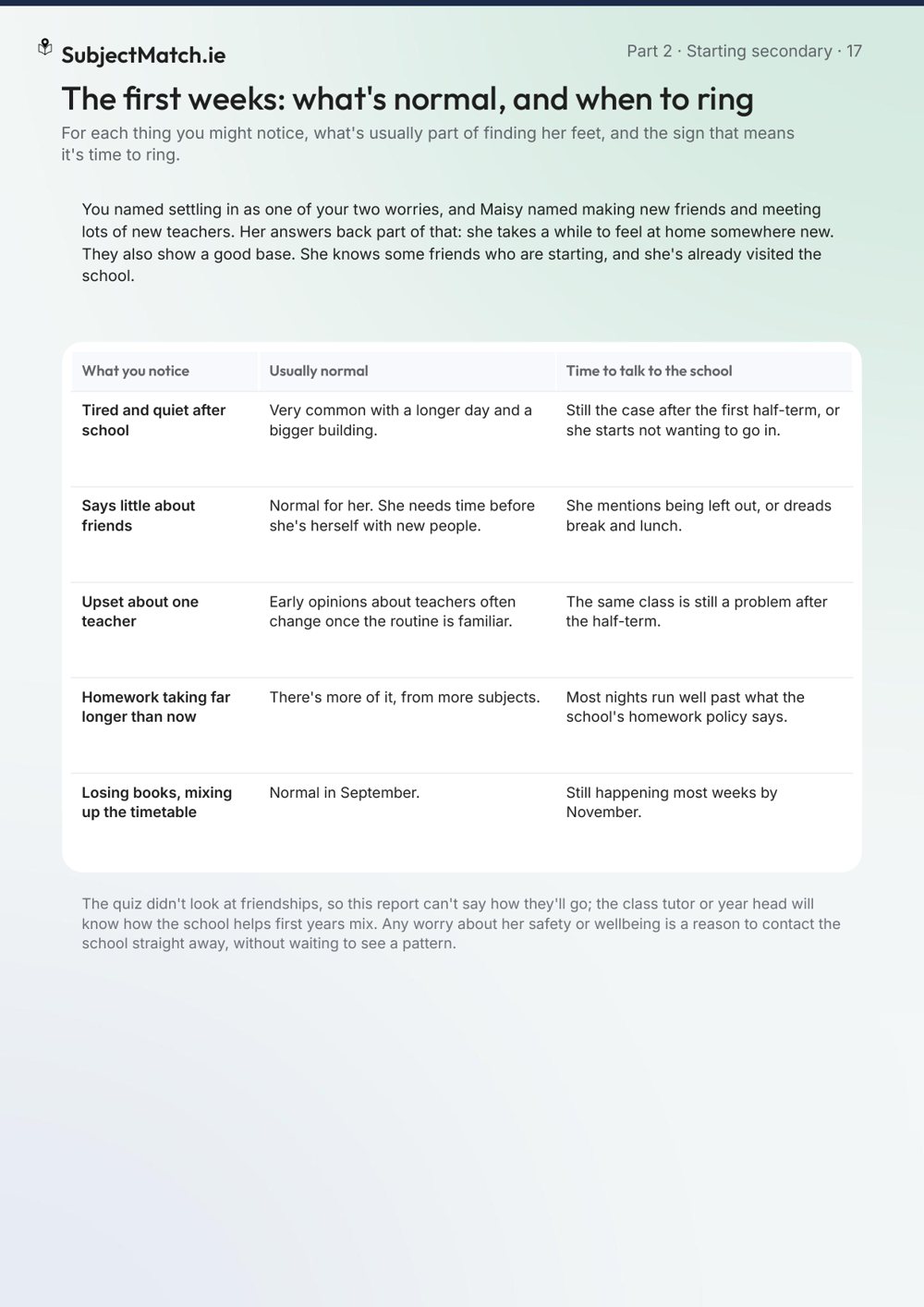
Is written for you as much as for your child, with a part just for you and one page for the fridge. Every top subject gets its own page on what it really involves.
Choices made early often close off later options without families realising. Very few students pick up a new subject at senior cycle, and moving down a level is far more common than moving up.
ESRI, Choices and Challenges
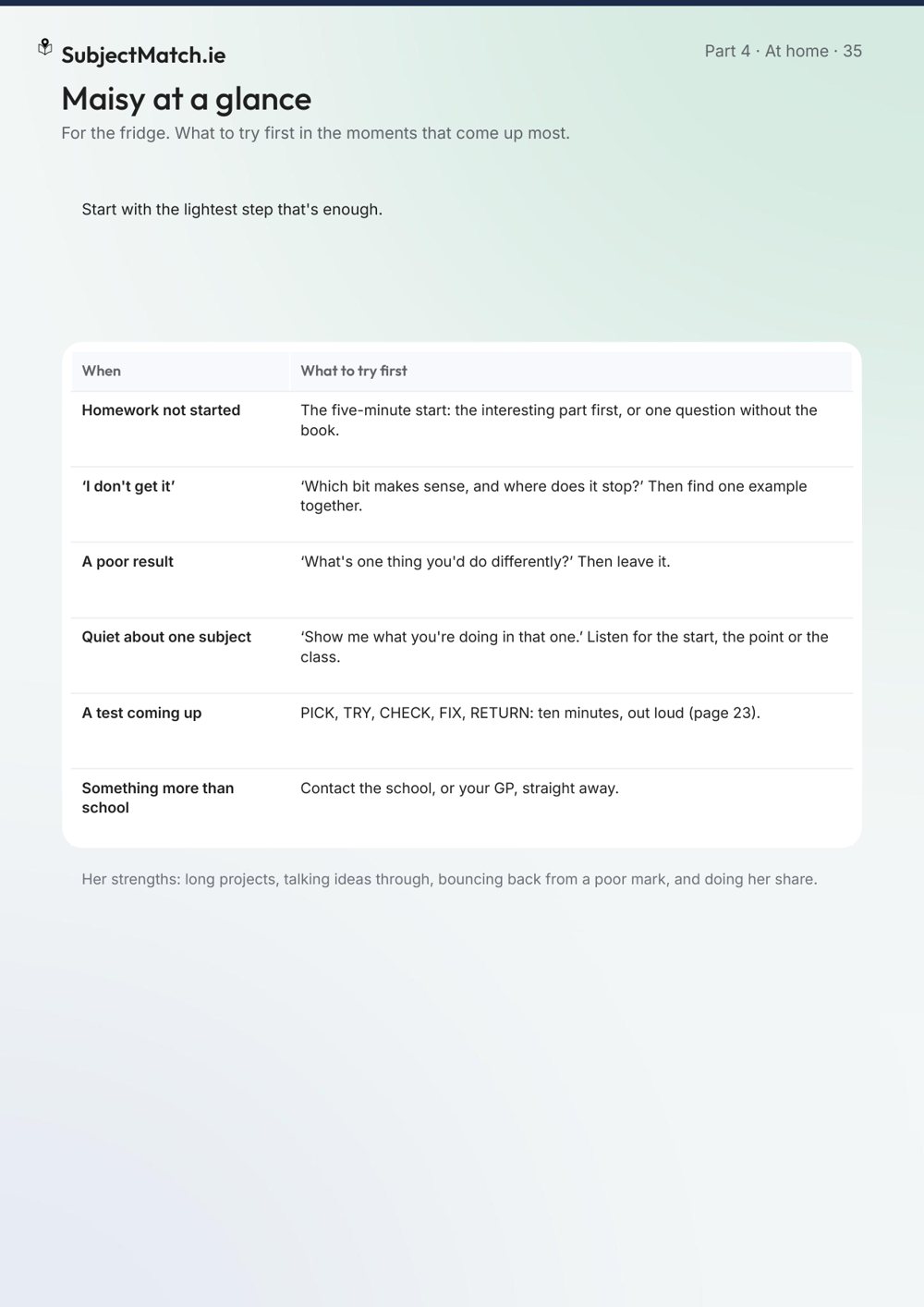
Has a page on what each choice keeps open and what it quietly closes, before the form goes in.
Most children settle in well, but around one in five worries about making new friends and misses primary school friends, and parents often don't spot those worries. Confidence about schoolwork tends to dip over the move.
ESRI, Growing Up in Ireland: Off to a Good Start?, Smyth, 2017
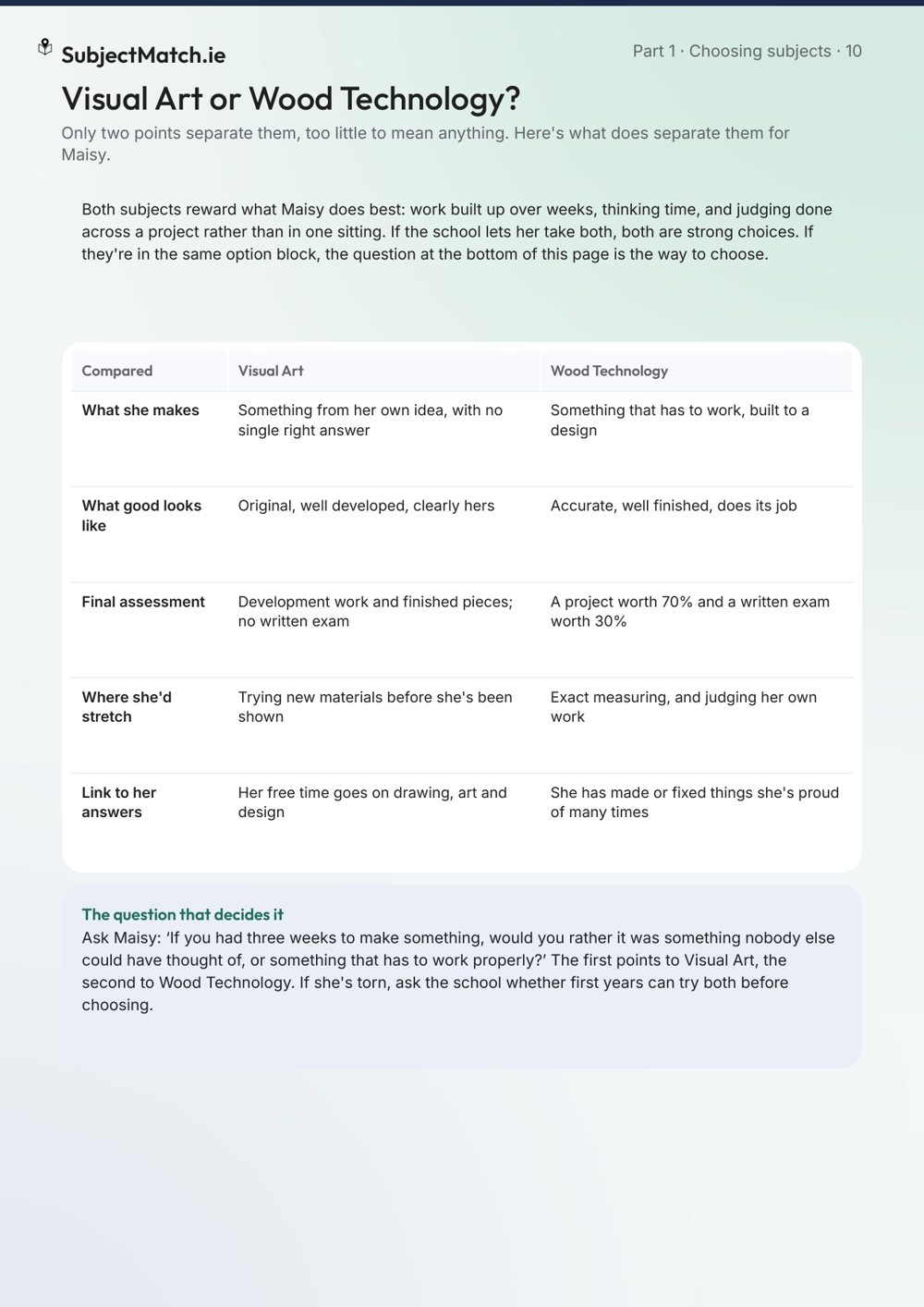
Covers the first weeks: what's normal, what passes, and when it makes sense to ring the school, plus what your child might say at home and what it usually means.
Second year is often where students drift or switch off, and habits built early matter for years.
ESRI Post-Primary Longitudinal Study, Smyth
Gives a whole part to study: a way of working that suits how your child learns, and a sample week to start from.
What happens to your answers
Four steps, from the kitchen table to your inbox.
Your child answers, then you add your part
About 20 minutes together. There are no right answers: the questions are about how they work, what they enjoy, and what's on their mind.
We look for patterns, not single answers
No one answer decides anything. A finding only makes the report when several answers point the same way.
Each subject is weighed against what it asks
Projects or exams, building or writing, steady work or bursts: each subject your child's school offers is compared with how your child works.
It's written, then a person reads it
AI tools help write the text from your answers and the subject facts. A person reads and checks every report before it reaches you.
What the findings mean
Where something isn't clear, the report says so and tells you how to check, instead of guessing.
The percentages compare subjects for your child. They aren't grades, and they aren't predictions.
The subject facts
What each subject involves, how it's assessed and what it leads to comes from official Irish sources: the NCCA, the State Examinations Commission, and CAO and college entry requirements. Schools differ, so the report always tells you what to check with yours.
What we keep private, and why
We don't publish our questions or how each answer is weighed. That's not secrecy for its own sake. A questionnaire you can see through is one you can steer, even without meaning to, and a steered answer gives you a worse report. What we do show you is every finding, the answers behind it, and what you can check next.
What the report isn't
- It isn't a psychological assessment or a diagnosis.
- It doesn't predict results or points.
- It doesn't replace your school's guidance counsellor. It gives you better questions to bring to them.
- Your answers are never used to train AI.
Sources
- Eccles, J. S. and Wigfield, A. (2002). Motivational beliefs, values, and goals. Annual Review of Psychology, 53, 109 to 132.
- Smyth, E. and Calvert, E. Choices and Challenges: Moving from Junior Cycle to Senior Cycle Education. The Liffey Press with the ESRI and NCCA. esri.ie
- Smyth, E. (2017). Off to a Good Start? Primary School Experiences and the Transition to Second-Level Education. Growing Up in Ireland. growingup.ie
- Smyth, E. and Hannan, C. (2002). Who Chooses Science? Subject Take-up in Second-Level Schools. ESRI.
- NCCA (ncca.ie), State Examinations Commission (examinations.ie), CAO (cao.ie).
Check the Irish subject information for yourself
Our reports interpret how the student's answers compare with subject demands; the official curriculum and admissions facts come from other sources. School offerings, assessment specifications and course entry requirements can change, so we ask families to confirm the details that affect their own decision.
Our matching scores are relative guidance signals, not predicted grades or a guarantee of future enjoyment, course admission or success.